
The Old English Blótorc
Ritual Classification and the Semantic Relationship of Blót and Blód
Abstract
The Old English nouns blót ("sacrifice") and blód ("blood") belong to distinct lexical families derived from separate Proto-Germanic roots. Their independent histories and meanings have long been recognized within Germanic philology. Yet the Old English glossarial tradition preserves the remarkable alternation blótorc / blódorc, allowing the same ritual vessel to be designated through either term. This article examines that alternation through the evidence of the Boulogne Prudentius Glosses and argues that its significance lies not in shared etymology or in lexical synonymy but in ritual classification.
A reconstruction of the semantic organization of the blót- and blód-families demonstrates that the former classifies persons, places, and objects according to participation in sacrificial action, whereas the latter organizes its semantic field around blood as material substance and the conditions arising from its presence or shedding. The manuscript evidence preserves a rare instance in which these independently organized lexical systems converge upon a single ritual implement. The study argues that, within this glossarial tradition, the vessel could be understood either through the sacrificial rite to which it belonged or through the blood associated with that rite. The alternation therefore illustrates not the collapse of two lexical families but the coexistence of complementary principles of ritual classification within Old English religious vocabulary.
Keywords: Old English; blót; blód; blótorc; Boulogne Prudentius Glosses; ritual classification; semantic fields; Anglo-Saxon lexicography; Germanic philology.
1. Introduction
Historical linguistics and ritual language do not always organize meaning according to the same principles. The former traces relationships among words through regular phonological and morphological development, while the latter often brings historically unrelated terms into close conceptual association through repeated ritual use. Words of independent origin may therefore come to occupy the same conceptual space, not because they share an etymology, but because they participate in the same ceremonial act. Such associations are especially characteristic of religious language, where objects, actions, and substances are frequently understood through their relationships within ritual practice rather than through their lexical history alone.1
The Old English nouns blót ("sacrifice") and blód ("blood") present an instructive example. Their etymologies are well established. Blót continues Proto-Germanic blótą, denoting sacrifice or cultic worship, while blód derives from Proto-Germanic blóþą, "blood."2 Throughout the surviving Old English corpus the two lexical families remain historically distinct and ordinarily retain separate semantic identities. Nothing in their inherited development suggests that the words were ever cognate or interchangeable.
The manuscript tradition, however, preserves an unexpected point of contact. In the Boulogne Prudentius Glosses, the compound blótorc appears as the Old English rendering of a Latin ritual vessel, while the marginal reading blódorc, entered by a second hand, designates the same object.3 The variation affects only the first element of the compound. In one case the vessel is identified through sacrifice; in the other, through blood.
The significance of this alternation has received little sustained attention. It is easily dismissed as an isolated scribal variant, and such an explanation may ultimately account for its origin. Yet even if the marginal reading arose through ordinary processes of textual transmission, its intelligibility remains a philological problem. A scribal substitution succeeds only insofar as the resulting form continues to make sense within its context. The question is therefore not simply how the variant arose, but why blód could function as an intelligible alternative to blót in the designation of the same ritual implement.
The present study argues that the relationship between the two compounds is best understood as one of ritual classification rather than lexical synonymy. It does not challenge the independent etymologies of blót and blód, nor does it propose that the two words had merged semantically in Old English. Instead, it suggests that the ritual context created a conceptual association sufficiently close that the same object could be classified according to different, yet complementary, semantic principles. The vessel could therefore be identified either through the sacrificial act in which it participated or through the blood associated with that act, while the lexical distinction between blót and blód remained intact.
The argument therefore proceeds from lexical history to semantic organization before returning to the manuscript evidence itself. Only after the independent structures of the blót- and blód-families have been established can the relationship preserved by blótorc and blódorc be interpreted.
2. The Lexical Families of Blót and Blód
Before examining the relationship suggested by blótorc and blódorc, it is first necessary to establish that blót and blód belong to historically independent lexical families. Were the two words etymologically related, the alternation preserved in the Boulogne Prudentius Glosses could be explained through ordinary lexical development. It is precisely because no such relationship exists that the variation itself requires explanation.
2.1. Blót
Old English blót belongs to a distinct Germanic lexical family denoting sacrifice, cultic worship, or ritual offering. The noun continues Proto-Germanic blótą, while the corresponding verb blótan derives from Proto-Germanic blótaną, "to sacrifice." Cognate forms occur throughout the Germanic languages, most prominently Old Norse blót and blóta, where the vocabulary remained productive well into the medieval period.4
The ultimate Indo-European origin of Proto-Germanic blótą remains uncertain. Although several etymologies have been proposed, none has achieved general acceptance.5 Whatever its earlier prehistory, the meaning of the Germanic word is remarkably stable throughout the surviving evidence. It denotes the performance of sacrifice or ritual worship rather than blood, the sacrificial victim, or the implements employed in the rite.
Old English preserves comparatively few derivatives of the family, a circumstance readily explained by the Christian context in which nearly all surviving texts were produced. The inherited vocabulary appears chiefly in legal prohibitions, biblical translation, homiletic literature, and glosses, where it consistently denotes pagan sacrifice or cultic worship viewed through Christian discourse.6
2.2. Blód
The history of blód presents no comparable uncertainty. Old English blód continues Proto-Germanic blóþą, with regular cognates throughout the Germanic languages, including Old Norse blóð, Old Saxon blód, Old High German bluot, and Gothic blóþ.7 The consistency of the comparative evidence leaves little doubt concerning either its inheritance or its primary meaning.
Unlike blót, whose semantic range remains largely confined to sacrificial activity, blód became one of the most productive nouns in Old English. Its derivatives extend into legal, poetic, medical, genealogical, and biblical discourse. Despite this breadth, the semantic center of the family remains constant. Whether referring to life, kinship, violence, covenant, or purification, these developments all proceed from the concrete reality of blood itself.
The historical distinction between the two lexical families is therefore clear. Blót denotes a ritual act; blód denotes a material substance. Their inherited histories remain separate, and their ordinary meanings do not overlap.
Because the two lexical families are historically independent, any relationship observed between them must arise not from common descent but from the contexts in which they are employed. The discussion therefore turns from etymology to semantics, asking how each family independently organizes the ritual world to which it belongs.
3. The Semantic Organization of the Blót-Family
The historical independence of the blót- and blód-families does not determine how they organize meaning. Lexical fields acquire coherence through the relationships established among their members in actual usage. The present section therefore examines not the etymology of blót, but the semantic principles governing the vocabulary derived from it.
Taken collectively, the surviving members of the blót-family exhibit a consistent semantic organization. Persons, places, and objects receive their identity through participation in sacrifice. The semantic center of the family is therefore neither an object nor a substance, but the ritual act itself.
3.1. The Sacrificial Act
The noun blót and the verb blótan form the semantic nucleus of the family. Throughout the surviving corpus these words denote the performance of sacrifice or cultic worship.8 Although nearly every attestation survives within Christian texts describing pagan practice, the lexical value of the words remains stable. They consistently denote the ritual act rather than its constituent elements.
This distinction is fundamental. The semantic center of the family is an event. Every derivative extends outward from sacrificial performance rather than from any physical object associated with it.
3.2. Persons
The agent noun blótere illustrates the first extension from the semantic center. The word denotes one who performs sacrifice, though Christian writers commonly employ it with the pejorative sense of "idolater."9 This change reflects Christian evaluation rather than semantic restructuring. Whether descriptive or condemnatory, the designation continues to define the individual through participation in sacrificial activity.
The identity of the officiant is therefore functional. The word classifies the person by what he does within the rite rather than by rank, lineage, or office.
3.3. Places
The same principle governs compounds denoting places associated with sacrifice. Forms such as blóthūs identify a location according to the rite performed there rather than according to its architecture or construction.10 The building derives its lexical identity from the sacrificial activity taking place within it.
This pattern accords with broader tendencies in Old English compound formation, where places are frequently designated according to their defining function. Within the blót-family, however, the relationship is especially transparent: sacrifice provides the organizing principle by which the place is understood.
3.4. Objects
The surviving vocabulary likewise classifies ritual implements according to their ceremonial function. Although comparatively few compounds survive, those that do identify objects through their participation in sacrifice rather than through their physical characteristics. Their identity is determined by the role they perform within the rite.
This observation becomes important in the discussion that follows. If ritual objects are ordinarily classified through sacrificial function, any alternative basis of classification requires explanation.
3.5. Semantic Organization
Viewed as a whole, the blót-family displays a coherent semantic organization. The ritual act forms the center from which the remaining vocabulary derives its meaning. Persons perform sacrifice. Places host sacrifice. Objects serve sacrifice. Each receives its identity through participation in the same ceremonial event.
The organization of the lexical family may therefore be summarized by a single question:
What participates in sacrifice?
This is more than a convenient description of the surviving compounds. It expresses the internal organization of the vocabulary itself. The derivatives of blót do not merely describe sacrifice; they classify the ritual world according to participation in the sacrificial act.
The blód-family exhibits an equally coherent organization, but according to a fundamentally different principle. Rather than extending from ritual action, it extends from the material reality of blood. The distinction between these two semantic systems forms the basis for the discussion that follows.
4. The Semantic Organization of the Blód-Family
Unlike the comparatively restricted vocabulary of blót, the lexical family of blód permeates nearly every genre of Old English literature. It appears in heroic poetry, legal prose, biblical translation, medical writing, and homiletic literature. Despite this breadth, the family exhibits a remarkably coherent semantic organization. Its derivatives are organized not around ritual action but around the material reality of blood itself.
4.1. Blood as Material Substance
The noun blód consistently denotes the physical substance of blood. Whether occurring in descriptions of battle, injury, sacrifice, disease, or biblical narrative, its primary reference remains concrete and material.11 Unlike blót, whose semantic center is an event, blód begins with a substance that exists independently of any particular ritual or social context.
This distinction governs the organization of the entire lexical family. Every major semantic development proceeds from blood as a tangible reality rather than from the actions in which it is shed.
4.2. Blood and Life
The first extension from this material center is life itself. Throughout the Old English corpus, blood functions as the visible sign of living existence. The loss of blood signifies the loss of life, while the preservation of blood signifies continued vitality.12
The semantic movement proceeds from substance to condition. Life is understood through blood because blood provides its visible manifestation. The lexical family therefore remains materially grounded even as it expands into progressively more abstract concepts.
4.3. Blood and Kinship
From the same material foundation arises the association between blood and common descent. The vocabulary of blód extends naturally into the language of ancestry, inheritance, familial obligation, and kindred identity.13 These developments do not replace the concrete meaning of the noun; they depend upon it. Shared blood becomes the material expression of shared origin.
Here again the semantic movement proceeds outward from substance rather than inward toward abstraction. Kinship is not an independent meaning imposed upon the word but a social relationship understood through the reality of blood.
4.4. Blood, Violence, and Guilt
Old English legal and heroic literature extends the semantic field still further. Bloodshed signifies not only physical injury but the enduring consequences of violence: feud, vengeance, liability, and compensation.14 In these contexts blood functions as the visible evidence of an act whose effects continue beyond the moment of injury.
The emphasis therefore falls less upon violence itself than upon the enduring condition created by the shedding of blood. The lexical family consistently classifies the realities that proceed from blood rather than the actions that produce it.
4.5. Blood in Christian Literature
The Christianization of England greatly expanded the textual environments in which blód appeared without altering its semantic organization. Translating Latin sanguis, Old English authors employed blód in discussions of covenant, martyrdom, redemption, purification, and sacrifice.15 These contexts introduced new theological associations while preserving the noun's primary reference to blood as material substance.
Even where blood acquires profound theological significance, it remains the material medium through which those realities are expressed. Covenant is established through blood, redemption accomplished through blood, and purification effected through blood. The semantic organization of the family therefore remains materially grounded despite its theological development.
4.6. Semantic Organization
The blód-family is organized according to a principle fundamentally different from that governing the vocabulary of blót. Whereas the latter classifies persons, places, and objects according to participation in sacrificial action, the former classifies the conditions and relationships arising from blood as material substance.
Its semantic organization may therefore be summarized by a single question:
What proceeds from blood?
Life proceeds from blood.
Kinship proceeds from blood.
Violence leaves blood.
Guilt follows blood.
Covenant is established through blood.
Purification is accomplished through blood.
The lexical family thus expands from a material center into progressively wider social, legal, and theological domains while preserving the concrete reality of blood as its organizing principle.
The distinction between the two lexical families is now established. Blót organizes the ritual world through participation in sacrifice; blód organizes human experience through the realities manifested by blood. Their semantic organizations remain independent throughout the Old English corpus. It is precisely that independence which gives the evidence of blótorc and blódorc its significance.
5. The Evidence of Blótorc
The semantic organization of the blót- and blód-families establishes the framework within which the evidence of blótorc must be interpreted. The argument ultimately turns upon a single gloss preserved in the Boulogne Prudentius Glosses. Before considering its implications, the textual evidence itself must first be examined.
Modern lexicographers generally encounter the compound through Bosworth-Toller, which records the entry:
blót-(blód-)orc vas in quo sacrificabant res impias.16
Taken in isolation, the dictionary entry obscures the very feature of the textual tradition upon which the present argument depends. Bosworth-Toller's citation refers to Alfred Holder's edition of the Boulogne Prudentius Glosses, where the evidence appears in considerably greater detail.17 There, under gloss no. 514, the Latin lemma is simpuium, a manuscript spelling of simpuvium, itself a variant of Latin simpulum, denoting a vessel employed in Roman sacrificial ritual.18 Holder records the Old English gloss blot orc beside the lemma and notes a marginal reading blód orc, entered am rechten Rande by a zweite Hand.19
The manuscript tradition does not preserve two unrelated lexical entries. It preserves one principal gloss together with a secondary marginal reading referring to the same object. The referent remains constant throughout the transmission. Only the first element of the compound changes.
The glossator's choice of orc is itself significant. Old English possessed several ordinary terms for vessels, bowls, and cups.20 Rather than attempting to reproduce the physical form of the Latin implement, the gloss classifies it according to its ritual function.21 The second element establishes the object as a vessel; the first identifies the sphere to which that vessel belongs.
In its principal form, blótorc conforms precisely to the semantic organization reconstructed in Section 3. The implement receives its identity through participation in sacrifice. It is a vessel belonging to blót.
The marginal form blódorc, however, classifies the same object according to a different principle. The vessel itself has not changed, nor has its ritual function. What changes is the basis upon which it is identified. Instead of being understood through the sacrificial act, it is understood through the blood associated with that act.
The contrast may therefore be expressed succinctly:
blót-orc — a vessel identified through sacrifice.
blód-orc — a vessel identified through blood.
The evidence warrants no stronger conclusion than this. The gloss does not demonstrate that blót and blód had become synonymous, nor does it suggest uncertainty concerning their historical origins. On the contrary, the transparency of both compounds depends upon the continued distinction between the two lexical families. The significance of the alternation lies elsewhere: the same ritual implement could be understood according to either classificatory principle without changing its identity.
The Christian setting of the gloss must likewise be recognized. The accompanying Latin explanation reflects the perspective of a Christian glossator describing a pagan implement and therefore cannot serve as independent evidence for Anglo-Saxon sacrificial practice. The present argument rests instead upon the Old English compounds themselves and their relationship within the manuscript tradition.
The Boulogne Prudentius Glosses thus preserve a rare and highly instructive piece of evidence. A ritual vessel first identified through sacrifice was later understood, by a second hand, through blood. Whether that reinterpretation arose through correction, explanation, or some other process remains uncertain. The manuscript nevertheless preserves the same philological question: why should both forms have remained equally intelligible as designations for the same ritual implement?
6. Scribal Error or Semantic Interpretation?
The preceding section established that the alternation between blótorc and blódorc belongs to the manuscript tradition itself. Holder records blótorc as the principal gloss and blódorc as a marginal addition by a second hand.22 The existence of the variant is therefore beyond dispute. Its significance remains to be determined.
Several explanations merit consideration. None should be dismissed a priori, and the evidence does not permit absolute certainty. The following discussion proceeds from the most economical explanations toward those requiring broader semantic assumptions.
6.1. Scribal Substitution
The simplest explanation is ordinary scribal substitution. The compounds differ by only a single consonant, and medieval manuscripts preserve countless examples of graphic confusion, assimilation, and the replacement of uncommon forms by more familiar vocabulary.23 Since blótorc is an exceedingly rare compound, a later scribe or reader might naturally have replaced its unfamiliar first element with the much more common noun blód.
This explanation readily accounts for the existence of the variant. It does not, however, account for its intelligibility. Scribal substitution explains how a reading may arise; it does not explain why that reading continued to identify the same ritual implement. Had the first element been replaced by an unrelated noun, the compound would no longer have functioned within its context. The substitution therefore presupposes that blód itself remained capable of identifying the object in question.
6.2. Graphic Similarity
Closely related is the possibility of graphic confusion. Old English manuscripts frequently exhibit variation in the representation of consonants, abbreviations, and ligatures, particularly where rare compounds are concerned.24 Such processes undoubtedly contributed to the transmission of many lexical variants.
Yet graphic similarity, like scribal substitution, addresses only the mechanism by which a reading may have emerged. It cannot explain why the altered compound remained semantically appropriate. Visual resemblance may generate a new reading; semantic coherence determines whether that reading is preserved.
6.3. Folk-Etymological Reinterpretation
A third possibility is reinterpretation through folk etymology. Rare or unfamiliar compounds are often reshaped according to more familiar lexical material, especially where the resulting form appears more transparent to later readers.25 Under this interpretation, blótorc would have been reanalyzed as blódorc because blód was both common and immediately intelligible.
This explanation is entirely plausible. Nevertheless, it leaves the central question unanswered. Folk etymology succeeds only where the reinterpretation itself appears meaningful. The issue therefore remains: why should "blood-vessel" have seemed an acceptable reinterpretation of "sacrifice-vessel"?
6.4. Marginal Gloss as Interpretation
Holder's description of the manuscript suggests another possibility. The reading blódorc appears not in the principal text but in the right-hand margin, entered by a second hand.26 Marginal additions commonly function as explanations, alternative readings, or lexical clarifications supplied by later readers. Their purpose is frequently interpretive rather than corrective.
If this is the case here, blódorc need not represent an attempt to replace blótorc. Instead, it may record an alternative way of understanding the compound. The second glossator encountered a vessel already identified through sacrifice and supplied a second designation based upon blood. Whether this reflects conscious interpretation or intuitive lexical association cannot now be determined. The manuscript preserves the interpretation, but not the reasoning that produced it.
6.5. The Remaining Problem
The explanations considered above are not mutually exclusive. Graphic similarity may have facilitated substitution; substitution may have encouraged reinterpretation; reinterpretation may have entered the manuscript as a marginal gloss. The processes by which the variant arose cannot now be reconstructed with certainty.
Yet every explanation leaves the same observation untouched. Regardless of how blódorc entered the manuscript, it remained intelligible as the designation of the same ritual vessel. The question is therefore no longer how the variant originated but why the substitution proved meaningful.
The alternation demonstrates neither lexical synonymy nor a common etymology. It demonstrates instead that, within this glossarial tradition, both nouns could function as meaningful principles by which the same ritual implement was classified. The significance of the variant lies not in its origin but in the conceptual relationship that made it intelligible.
The final section considers that relationship. It asks not how blódorc entered the manuscript, but what its presence reveals about the classification of ritual objects within Old English religious vocabulary.
7. Ritual Classification and the Semantic Relationship of Blót and Blód
The discussion has now established the conditions under which the evidence may be interpreted. The lexical families of blót and blód remain historically independent, yet the Boulogne Prudentius Glosses preserve a ritual vessel identified through either term. The remaining question is therefore not one of textual transmission but of semantic interpretation.
The manuscript evidence suggests that the two compounds classify the same object according to different principles. In blótorc, the vessel derives its identity from the sacrificial act to which it belongs. In blódorc, it derives its identity from the blood associated with that same act. The object itself remains unchanged. Only the basis upon which it is identified has shifted.
Throughout the Old English corpus, blót continues to denote sacrifice and blód continues to denote blood. Neither word assumes the ordinary meaning of the other. The alternation preserved in the Boulogne Prudentius Glosses therefore cannot be explained by semantic merger. Rather, each compound remains intelligible precisely because the meanings of its constituent elements remain distinct.
The relationship between the two forms is consequently classificatory rather than lexical. The principal gloss identifies the vessel through the rite in which it participates. The marginal gloss identifies the same vessel through the material substance most closely associated with that rite. The two designations are not interchangeable in every context, nor do they describe different objects. They represent different ways of understanding the same ritual implement.
This observation provides a coherent explanation for the semantic problem identified in the preceding section. Whether blódorc arose through substitution, reinterpretation, or explanatory glossing, its preservation depended upon its intelligibility. That intelligibility did not arise because blót and blód had become synonymous, but because each offered a meaningful basis for classifying the vessel within its ritual context. The relationship between the two compounds is therefore conceptual rather than historical, classificatory rather than lexical.
The evidence permits no broader conclusion than this.27 A single gloss cannot establish a general theory of Old English religious language, nor can it determine the semantic organization of Germanic ritual vocabulary as a whole. It can, however, preserve an interpretive moment within the manuscript tradition. Here, the lexical choices of successive glossators reveal that the same ritual object could be understood through more than one, yet equally intelligible, principle of classification.28
The significance of blótorc and blódorc therefore lies not in the history of either word individually, but in the relationship between them. Within this glossarial tradition, sacrifice and sacrificial blood were conceptually associated closely enough that either could identify the same ritual vessel without erasing the lexical distinction between blót and blód. The alternation therefore preserves more than a scribal variant. It preserves two complementary principles by which the same ritual object could be understood.
Bibliography
Bell, Catherine. Ritual: Perspectives and Dimensions. Rev. ed. New York: Oxford University Press, 2009.
Bosworth, Joseph, and T. Northcote Toller. An Anglo-Saxon Dictionary. Edited by T. Northcote Toller. Oxford: Clarendon Press, 1898.
Bosworth, Joseph. An Anglo-Saxon Dictionary Online. Edited by Christ Sean and Ondřej Tichý. Prague: Faculty of Arts, Charles University, 2014.
Bremmer, Rolf H., Jr. An Introduction to Old English. Amsterdam: John Benjamins, 2009.
Brown, Michelle P. A Guide to Western Historical Scripts from Antiquity to 1600. London: British Library, 1990.
Coșeriu, Eugeniu. "Pour une sémantique diachronique structurale." Travaux de Linguistique et de Littérature 2 (1964): 139–186.
Godden, Malcolm. "The Anglo-Saxons and the Goths." Journal of English and Germanic Philology 85 (1986): 493–503.
Gneuss, Helmut, and Michael Lapidge. Anglo-Saxon Manuscripts: A Bibliographical Handlist. Toronto: University of Toronto Press, 2014.
Grimes, Ronald L. The Craft of Ritual Studies. New York: Oxford University Press, 2014.
Hines, John. Voices in the Past: English Literature and Archaeology. Cambridge: D. S. Brewer, 2004.
Hogg, Richard M., ed. The Cambridge History of the English Language. Vol. 1. Cambridge: Cambridge University Press, 1992.
Hogg, Richard M., and R. D. Fulk. A Grammar of Old English. Vol. 2, Morphology. Oxford: Wiley-Blackwell, 2011.
Holder, Alfred. "Die Bouloneser angelsächsischen Glossen zu Prudentius." Germania 23, new ser. 11 (1878): 385–403.
Kastovsky, Dieter. "Semantics and Vocabulary." In The Cambridge History of the English Language. Vol. 1. Edited by Richard M. Hogg, 290–408. Cambridge: Cambridge University Press, 1992.
Kroonen, Guus. Etymological Dictionary of Proto-Germanic. Leiden Indo-European Etymological Dictionary Series 11. Leiden: Brill, 2013.
Lewis, Charlton T., and Charles Short. A Latin Dictionary. Oxford: Clarendon Press, 1879.
Marsden, Richard. The Text of the Old Testament in Anglo-Saxon England. Cambridge: Cambridge University Press, 1995.
Meritt, Herbert Dean. The Old English Prudentius Glosses at Boulogne-sur-Mer. Stanford, CA: Stanford University Press, 1959.
Mitchell, Bruce, and Fred C. Robinson. A Guide to Old English. 8th ed. Oxford: Wiley-Blackwell, 2012.
Trier, Jost. Der deutsche Wortschatz im Sinnbezirk des Verstandes. Heidelberg: Carl Winter, 1931.
Wormald, Patrick. The Making of English Law: King Alfred to the Twelfth Century. Vol. 1. Oxford: Blackwell, 1999.
Reference Works
Dictionary of Old English: A–I Online. Toronto: Dictionary of Old English Project, University of Toronto.
Dictionary of Old English Corpus. Toronto: Dictionary of Old English Project, University of Toronto.
Afterword: The Blótorc in Reconstruction
The preceding study was written as an exercise in philology rather than theology. It sought to explain an obscure Old English gloss by examining its language, manuscript history, and semantic organization. Its conclusions are necessarily limited by the evidence. The article does not demonstrate how the Anglo-Saxons conducted sacrifice, nor does it prove the existence of a standardized ritual vessel called a blótorc. Such claims would extend beyond what the surviving sources permit.
For those engaged in the reconstruction of Anglo-Saxon heathen practice, however, the study offers something different. It provides a historically attested Old English name for a ritual vessel and, more importantly, a glimpse into the way that vessel could be understood within the language of sacrifice.
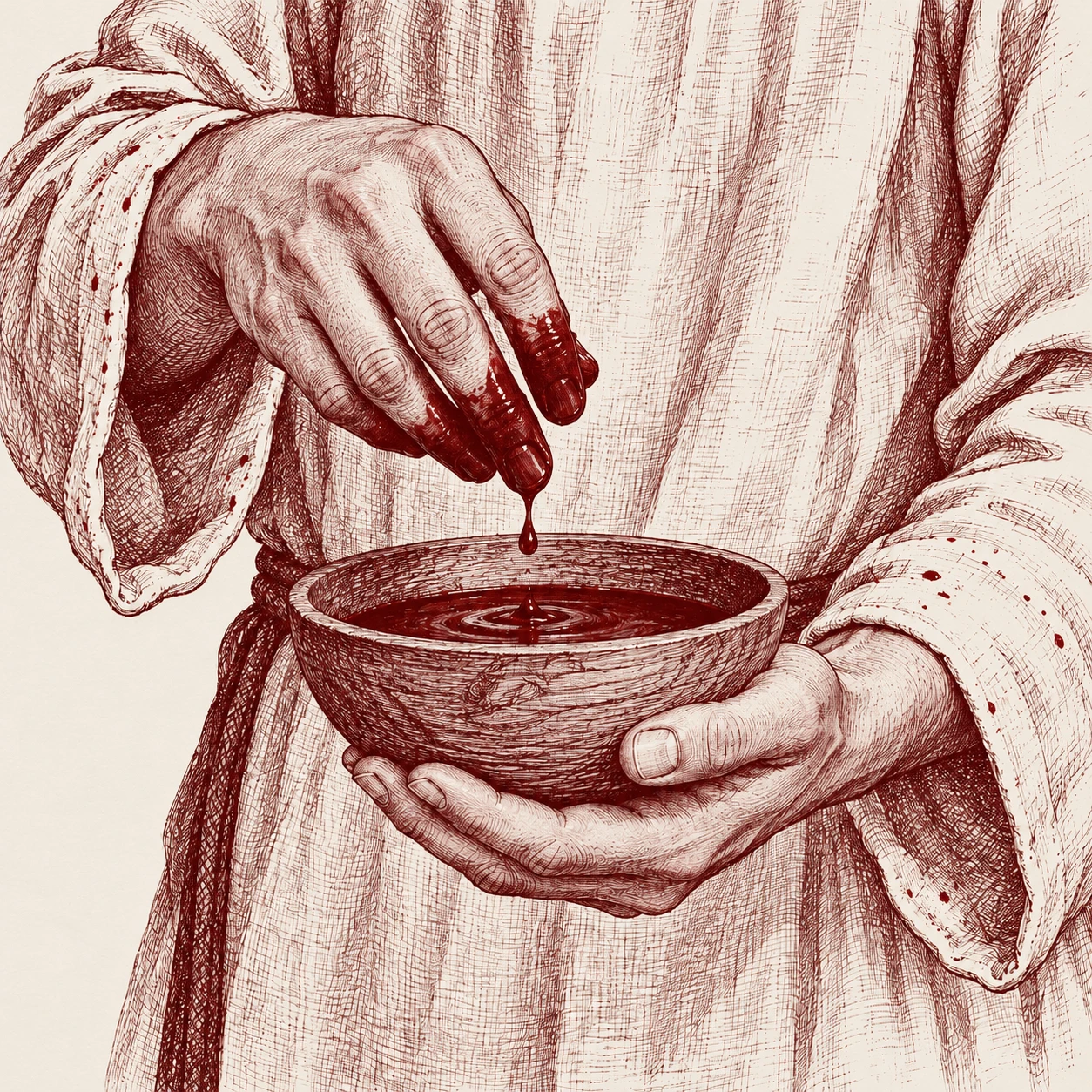
The principal gloss, blótorc, identifies the vessel through the rite itself. It is the vessel of blót. Its identity is not determined by its shape, its material, or its craftsmanship, but by its participation in sacrifice. A wooden bowl sitting upon a shelf is simply a bowl. It becomes a blótorc only when it enters the ritual act for which it is set apart.
The marginal reading, blódorc, offers a complementary perspective. Whether it represents correction, reinterpretation, or explanation cannot be known with certainty. Yet its preservation demonstrates that the vessel could also be understood through the blood associated with the sacrifice. The object has not changed; only the rite has progressed. What was first identified by the act of sacrifice may now be understood through the substance that sacrifice has brought forth.
For the reconstructionist, this distinction is theologically suggestive. The vessel need not possess a permanent or intrinsic sanctity. Its significance arises from its relationship to the rite. Before sacrifice it is prepared for blót; during sacrifice it serves blót; once blood is received within it, the same vessel may be contemplated through blód. These are not different objects but different moments in the liturgical life of the same object.
This understanding accords well with a broader principle that has emerged throughout the development of the Fyrnsegen. Ritual objects do not possess meaning in isolation. They derive their identity from the ordered relationships in which they participate. A torch becomes the Wéohende only when it bears the fire of the wíh. A boundary rope becomes the heargband only when it marks the holy enclosure. A field becomes an ealh only when Wéoh is established within it. Likewise, a vessel becomes a blótorc because it serves the sacrifice.
This perspective also guards against an error common in modern reconstruction. It is tempting to seek holiness in objects themselves, as though ritual implements possessed an independent sacred quality. The language of the gloss suggests something more restrained. The vessel is defined not by inherent sanctity but by function. It belongs to the sacrifice because it participates in the sacrifice. Whatever holiness it acquires arises from that participation rather than preceding it.
Within the sacrificial order proposed elsewhere in the Fyrnsegen, the place of the blótorc becomes readily apparent. It belongs first to blótan, for it is the vessel prepared for the offering. Yet it naturally accompanies the transition into blétsian, where blood becomes the means by which persons, objects, and the sacred enclosure are blessed. The vessel that was first understood through sacrifice now bears the blood through which blessing proceeds. Without changing its identity, it stands at the meeting point of the two semantic worlds explored in the present study.
None of this should be mistaken for a claim about historical Anglo-Saxon ritual. It is, rather, an exercise in faithful reconstruction. Philology establishes the boundaries within which reconstruction may responsibly proceed. Theology and liturgy then ask how those historical insights may be embodied in living practice. The reconstructionist should neither ignore the evidence nor imagine that the evidence speaks where it is silent. Between those two errors lies the work of rebuilding.
If the blótorc has a lasting contribution to make, it is not because it answers every question about Germanic sacrifice. It is because it reminds us that ritual language is relational. Objects receive their names through the work they perform, the realities they mediate, and the place they occupy within the liturgy. The blótorc is therefore more than a bowl. It is a vessel whose identity is found in sacrifice itself—a humble implement whose name still bears witness to the ordered relationship between offering and blood, action and substance, rite and remembrance.
Notes
On semantic fields as historical systems of lexical relationships, see Jost Trier, Der deutsche Wortschatz im Sinnbezirk des Verstandes (Heidelberg: Carl Winter, 1931); Eugeniu Coșeriu, "Pour une sémantique diachronique structurale," Travaux de Linguistique et de Littérature 2 (1964): 139–186. The present study applies these principles to the organization of ritual vocabulary rather than proposing a general theory of semantic change. ↩
Guus Kroonen, Etymological Dictionary of Proto-Germanic, Leiden Indo-European Etymological Dictionary Series 11 (Leiden: Brill, 2013), s.vv. "blótą" and "blóþą"; Joseph Bosworth and T. Northcote Toller, An Anglo-Saxon Dictionary Online, ed. Christ Sean and Ondřej Tichý (Prague: Faculty of Arts, Charles University, 2014), s.vv. "blót" and "blód." ↩
Alfred Holder, "Die Bouloneser angelsächsischen Glossen zu Prudentius," Germania 23, new ser. 11 (1878): 397, no. 514; Herbert Dean Meritt, The Old English Prudentius Glosses at Boulogne-sur-Mer (Stanford, CA: Stanford University Press, 1959), Introduction. Holder records blótorc as the principal gloss and blódorc as a marginal addition by a second hand (am rechten Rande, 2. Hd.). ↩
Guus Kroonen, Etymological Dictionary of Proto-Germanic, Leiden Indo-European Etymological Dictionary Series 11 (Leiden: Brill, 2013), s.vv. "blótą" and "blótaną"; Jan de Vries, Altnordisches Etymologisches Wörterbuch, 2nd ed. (Leiden: Brill, 1962), s.vv. "blót," "blóta." ↩
Kroonen, Etymological Dictionary, s.v. "blótą." Earlier proposals remain inconclusive and have not produced a generally accepted Proto-Indo-European derivation. ↩
Bosworth and Toller, An Anglo-Saxon Dictionary Online, s.vv. "blót," "blótan"; Dictionary of Old English: A–I Online (Toronto: Dictionary of Old English Project), s.vv. "blót," "blótan." ↩
Kroonen, Etymological Dictionary, s.v. "blóþą"; Bosworth and Toller, An Anglo-Saxon Dictionary Online, s.v. "blód"; Dictionary of Old English: A–I Online, s.v. "blód." ↩
Bosworth and Toller, An Anglo-Saxon Dictionary Online, s.vv. "blót," "blótan"; Dictionary of Old English: A–I Online (Toronto: Dictionary of Old English Project), s.vv. "blót," "blótan." Representative occurrences appear in the Old English Heptateuch, Ælfric's homilies, and vernacular glosses, where the words consistently denote sacrificial or idolatrous worship. ↩
Bosworth and Toller, s.v. "blótere"; Dictionary of Old English, s.v. "blótere." On the Christian reinterpretation of inherited pagan terminology, see Malcolm Godden, "The Anglo-Saxons and the Goths," Journal of English and Germanic Philology 85 (1986): 493–503. ↩
Bosworth and Toller, s.v. "blóthús"; Dictionary of Old English, s.v. "blóthūs." On functional designation in Old English compounds, see Dieter Kastovsky, "Semantics and Vocabulary," in The Cambridge History of the English Language, vol. 1, ed. Richard M. Hogg (Cambridge: Cambridge University Press, 1992), 290–408. ↩
Bosworth and Toller, An Anglo-Saxon Dictionary Online, s.v. "blód"; Dictionary of Old English: A–I Online (Toronto: Dictionary of Old English Project), s.v. "blód." Representative occurrences include Beowulf 846–849, 2966–2969; Genesis A 1284–1292; and the Old English Heptateuch. ↩
Compare the Old English translation of Leviticus 17:11 in the Heptateuch, together with poetic usage in Genesis A and Exodus, where the shedding of blood functions as the visible expression of the loss of life. ↩
Bosworth and Toller, s.v. "blód"; Dictionary of Old English, s.v. "blód." On blood, kinship, and inherited obligation in Anglo-Saxon legal thought, see Patrick Wormald, The Making of English Law: King Alfred to the Twelfth Century, vol. 1 (Oxford: Blackwell, 1999), 310–338. ↩
See Laws of Ine 23–24; Laws of Alfred 27; and Wormald, Making of English Law, 180–250, for the relationship between bloodshed, feud, and legal compensation. ↩
Richard Marsden, The Text of the Old Testament in Anglo-Saxon England (Cambridge: Cambridge University Press, 1995), 246–269; Dictionary of Old English Corpus. Old English translators consistently employ blód to render Latin sanguis across biblical contexts. ↩
Joseph Bosworth and T. Northcote Toller, An Anglo-Saxon Dictionary, ed. T. Northcote Toller (Oxford: Clarendon Press, 1898), s.v. "orc"; An Anglo-Saxon Dictionary Online, ed. Christ Sean and Ondřej Tichý (Prague: Faculty of Arts, Charles University, 2014), s.v. "orc." ↩
Alfred Holder, "Die Bouloneser angelsächsischen Glossen zu Prudentius," Germania 23, new ser. 11 (1878): 397, no. 514. ↩
Lewis and Short define simpulum as a small sacrificial ladle or vessel used especially in Roman cult, while simpuvium represents a documented orthographic variant. See Charlton T. Lewis and Charles Short, A Latin Dictionary (Oxford: Clarendon Press, 1879), s.vv. "simpulum," "simpuvium." ↩
Holder, "Die Bouloneser angelsächsischen Glossen," 397, no. 514: "simpuium … blot orc … und am rechten Rande blód orc (2. Hd.)." See also Herbert Dean Meritt, The Old English Prudentius Glosses at Boulogne-sur-Mer (Stanford, CA: Stanford University Press, 1959), Introduction. ↩
Bosworth and Toller, s.vv. "orc," "bolla," "cuppe," and "fæt." The existence of several ordinary vessel terms underscores that the compound identifies the implement by ritual association rather than by physical description. ↩
Archaeological examples indicate that the Roman simpulum (also transmitted in medieval manuscripts as simpuvium) was a small bronze or silver ladle with a deep bowl and a long handle employed for drawing and pouring sacrificial wine. Its physical form is not especially distinctive and could readily have been described by ordinary Old English terms for bowls, cups, or vessels. The glossator's choice of blótorc is therefore noteworthy because it does not translate the object's morphology but classifies it according to its ritual function. See Lewis and Short, A Latin Dictionary, s.vv. "simpulum," "simpuvium." ↩
Alfred Holder, "Die Bouloneser angelsächsischen Glossen zu Prudentius," Germania 23, new ser. 11 (1878): 397, no. 514. ↩
Richard M. Hogg and R. D. Fulk, A Grammar of Old English, vol. 2: Morphology (Oxford: Wiley-Blackwell, 2011), 1–18; Bruce Mitchell and Fred C. Robinson, A Guide to Old English, 8th ed. (Oxford: Wiley-Blackwell, 2012), 271– 278. ↩
Helmut Gneuss and Michael Lapidge, Anglo-Saxon Manuscripts: A Bibliographical Handlist (Toronto: University of Toronto Press, 2014), Introduction; Michelle P. Brown, A Guide to Western Historical Scripts from Antiquity to 1600 (London: British Library, 1990), 66–83. ↩
Dieter Kastovsky, "Semantics and Vocabulary," in The Cambridge History of the English Language, vol. 1, ed. Richard M. Hogg (Cambridge: Cambridge University Press, 1992), 290–408. ↩
Holder, "Die Bouloneser angelsächsischen Glossen," 397, no. 514: "und am rechten Rande blód orc (2. Hd.)." On the interpretive function of marginal glosses, see Herbert Dean Meritt, The Old English Prudentius Glosses at Boulogne-sur-Mer (Stanford, CA: Stanford University Press, 1959), Introduction. ↩
The argument advanced here concerns the semantic interpretation of a single glossarial tradition and should not be generalized beyond the evidence. The Boulogne Prudentius Glosses preserve an interpretive moment within the manuscript tradition rather than a comprehensive description of Old English ritual vocabulary. ↩
On the importance of glosses as witnesses to medieval lexical interpretation rather than simple translation, see Herbert Dean Meritt, The Old English Prudentius Glosses at Boulogne-sur-Mer (Stanford, CA: Stanford University Press, 1959), Introduction; Alfred Holder, "Die Bouloneser angelsächsischen Glossen zu Prudentius," Germania 23, new ser. 11 (1878): 385–403. ↩