
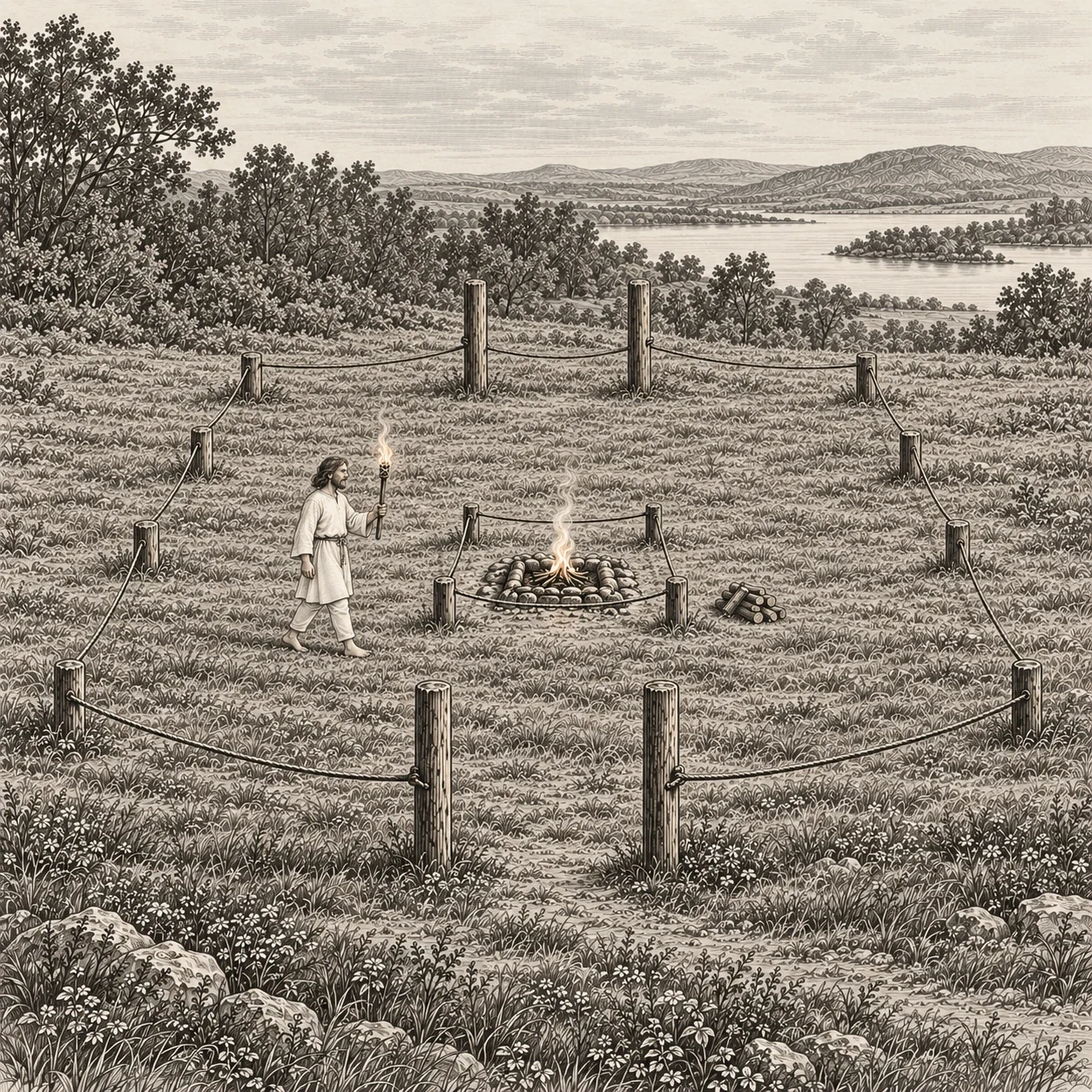
The Wéohende gealdor belongs to the bearing of fire, the bidding of peace, the exclusion of disorder, and the closing of the sacred enclosure. Its words and the procession form one deed; the gealdor gives voice to the work as it is accomplished. What the heargweard says, he does. What he does, the gealdor gives its appointed meaning.
The name itself identifies the work. Wéohende joins wéoh with ende, the end or boundary; its meaning is “sacred precinct boundary.” The gealdor takes its name from the boundary established through its performance. The fire proceeds from the centre, and its passage establishes the sacred precinct’s appointed limit.
The heargweard, the keeper of the sanctuary, takes fire from the central flame of the wíh and bears it around the surrounding hearg. Together these form the ealh, the whole sacred enclosure. The distinction between them governs the rite from its beginning. The wíh holds the central fire; the hearg receives the holiness extended from that source. The procession establishes their proper relationship, joining the middle to the boundary while preserving the character of each.
The gealdor accompanies this work because speech itself has work to do. It addresses those gathered, commands the departure of those who have no place within the enclosure, and calls upon Þunor to hallow the ealh. Its words are spoken to particular beings, at particular places, while the fire is carried along its appointed course. Removed from that deed, the written verses preserve the words of the rite; they do not contain its whole performance.
The gealdor and its revision
The gealdor was originally composed by Swain Wodening. Its familiar structure was present from the beginning: two passages concerning the bearing of fire, each followed by an invocation of Þunor, with that invocation repeated at the close. The first passage addressed the ælwihtas; the second addressed outlaws. The movement between peace within and exclusion at the boundary was therefore already part of the composition.
Some of its language required further work. The original refrain, Thunor wéoh, placed the word wéoh where a verb of consecration was needed. Swain later altered this to wéoha, attempting to supply the missing command; the intention was plain, but adding a vowel did not in itself establish the required verb.
Many years later, Cynemund, Brian Smith, returned to the language of the gealdor.
Working from fulwían, “to baptize,” literally “to sanctify fully,” and its imperative fulwá, he identified wían, “to sanctify,” and the command wía, “sanctify.” The verb and its imperative are preserved in these compound forms; removing the prefix ful- gives the command employed in the revised invocation: Þunor, wía þisne ealh—“Þunor, sanctify this ealh.” Other alterations concerned the forms of the beings addressed, the keeping of frið, and the ease with which the words could be spoken during the procession.
The imperative wía
The revised invocation employs wía, “sanctify,” from the restored verb wían, “to sanctify.” In this reconstruction, wí- is retained as the stem and -a supplies the singular imperative ending, following the pattern of Class II weak verbs. The long í belongs to the stem; it remains when the verb becomes a direct appeal to the god.
The invocation therefore reads: Þunor, wía þisne ealh—“Þunor, sanctify this ealh.” The singular imperative addresses Þunor himself; þisne ealh names the whole enclosure over which his consecrating action is sought.
The words of the rite
Old English
Fyr ic bere ymb friðgearde,
Ond béode mannum frið healdan,
Líeg ic bere tó belúcan,
Béode ælwihtas fléogan aweg.
Þunor, wía; Þunor, wía;
Þunor, wía þisne ealh.
Fyr ic bere ymb friðgearde,
Ond béode mannum frið healdan,
Líeg ic bere tó belúcan,
Béode utlagan féran aweg.
Þunor, wía; Þunor, wía;
Þunor, wía þisne ealh.
Þunor, wía; Þunor, wía;
Þunor, wía þisne ealh.
Modern English
The intended sense
Fire I bear around the peace-enclosure,
And bid men hold the peace;
Flame I bear to close it,
And bid alien beings fly away.
Þunor, sanctify; Þunor, sanctify;
Þunor, sanctify this ealh.
Fire I bear around the peace-enclosure,
And bid men hold the peace;
Flame I bear to close it,
And bid outlaws go away.
Þunor, sanctify; Þunor, sanctify;
Þunor, sanctify this ealh.
Þunor, sanctify; Þunor, sanctify;
Þunor, sanctify this ealh.
The keeping of peace
Several revisions are small upon the page. Ælwihta became ælwihtas; utlaga became utlagan. The revised forms identify the plural beings commanded to depart. The first term concerns alien or uncanny creatures; the second concerns men standing outside lawful peace. Their difference matters to the work of the rite.
The alteration from Ond béode men frið fremman to Ond béode mannum frið healdan carries a more substantial consequence. The older wording was intelligible, but the revised line states more exactly what is required of those gathered: they are bidden to hold frið; to keep and preserve the peace under which the sanctuary may be established.
Frið is sustained by right relations, by obligations acknowledged and kept, by restraint where restraint is owed. It blooms where its conditions are maintained. Men cannot summon it merely by announcing that it exists; they must conduct themselves in a manner that permits it to endure. The procession establishes such conditions, and the people within the enclosure are charged with keeping them.
The change to healdan therefore reaches beyond a preference in translation. It makes the obligation plain. Mannum identifies those to whom the bidding is addressed; frið healdan tells them what they must do. It also removes the close succession of frið fremman, which Cynemund found awkward in the mouth. A gealdor must be borne in the voice as surely as the torch is borne in the hand; its language must serve the deed during its performance.
This bidding comes near the beginning of each passage because peace among those gathered is a condition of the work. A sanctuary cannot be properly established while its people continue to bring quarrel and disorder into it. Their conduct belongs to the condition of the place. The boundary will exclude what threatens the sanctuary from without; those within must answer for what they themselves bring into its keeping.
The same requirement explains the two commands of departure. The first concerns the unseen beings whose presence is incompatible with the sanctuary being established. Ælwihtas is not used here as an indiscriminate dismissal of every unseen presence. The rite makes a distinction between those who belong within the appointed order and those who would disturb it.
The second passage turns to human disorder. The utlagan stand outside the lawful peace which those within are charged to hold. Their exclusion answers to the earlier bidding; a man cannot refuse the obligations of frið and nevertheless claim his place under its protection. The enclosure requires a distinction that applies to men as well as to spirits.
These are two parts of the same work. The sanctuary must possess an inward order and a boundary capable of maintaining it. The people are bidden to keep the peace; those who cannot stand within that peace are bidden to depart. The fire passes along the boundary as these distinctions are spoken.
The living fire
Yet the procession begins before the first of these words is uttered. Its beginning lies at the central fire of the wíh.
For this rite, that flame is brought forth by friction. It is not borrowed from a household hearth or carried in from another established fire. Wood is worked against wood; the ember is nursed by breath until it takes flame. The labour of kindling belongs to the establishment of the sanctuary. The fire is brought forth for this place and this work; once established, it becomes the living centre from which the procession proceeds.
The torch receives its flame there. Its fire is continuous with the central fire; the heargweard carries outward what has already been established at the middle. The source remains burning within the wíh while its flame is borne through the hearg to the limits of the enclosure.
This continuity is essential. The boundary receives its sacred consequence through its relation to the centre. Every step of the procession extends that relation; every word gives direction to the work being performed. The heargweard bears a living flame whose origin remains present in what it accomplishes.
Þunor and the thunderbolt
Þunor is invoked because he wields the divine thunderbolt, his club, the slecg. With it he strikes the wyrm and fells the giants; through its force the ordered world is defended against those who would undo its bounds. The thunderbolt brings heavenly fire to earth, leaving flame in the wake of its stroke.
The living fire of the wíh bears this relation to Þunor’s victorious power. When the heargweard takes flame from that source and carries it around the hearg, he calls upon the god whose club drives back the enemies of order. The fire traces the boundary; the gealdor invokes Þunor in its establishment.
To speak of Þunor here simply as a god of protection would leave much unsaid. The protection belongs to an act of establishing and maintaining order. The same power that drives back the world’s enemies gives consequence to the boundary being traced by the heargweard. The earthly flame bears this relationship into the sanctuary; its passage is joined to the invocation of the god.
The refrain therefore belongs within the procession. The heargweard does not complete an independent piece of human work and afterwards ask Þunor to approve it. He calls upon the god while the work is being accomplished. The visible fire, its appointed movement, and the divine action sought in the invocation belong to one rite.
Þunor, wá þisne ealh.
Þunor, sanctify this ealh.
Wéoh and hálig
Here the distinction between wéoh and hálig must be kept clear. Within Fyrnsegen these name different aspects of the sacred order; treating them as interchangeable would conceal what the procession accomplishes.
Wéoh is the divine quality borne in the living fire. The wíh is its central seat. Hálig is the condition established in the surrounding hearg through the proper extension of that power, under the conditions declared and maintained by the rite.
The torch therefore carries wéoh. The hearg becomes hálig through the completed work.
The distinction remains after the fire has passed around the boundary. The hearg does not become another wíh; the source does not cease to be the source because its power has been extended. The sanctuary consists in the right relation between the central sacred presence and the holy field surrounding it. Its parts are joined through their differences.
Nor does the bearing of fire alone exhaust the rite. The flame is carried along an appointed boundary; frið is required of those gathered; disruptive beings are commanded to depart; Þunor is invoked. The holiness of the hearg belongs to this whole deed. Fire, speech, conduct, and movement establish together what none of them, taken separately, would fully accomplish.
One circuit, two halves
The arrangement of the verses follows that movement.
During the first half of the circuit, the heargweard bears the fire, bids the keeping of frið, and commands the alien beings to depart. At the halfway point he pauses for the first refrain. Þunor is invoked while the boundary remains unfinished; the invocation accompanies the work at its turning.
The procession then continues. The second passage renews the bidding of frið and commands the departure of outlaws. Upon returning to the starting place, the heargweard sings the second refrain. The boundary has now been traversed in full; the living fire has been carried from its source to the whole appointed limit.
The final repetition completes the gealdor at the close of that circuit. It does not require another journey around the enclosure. Its words bring the accomplished movement again before Þunor, naming the sanctuary that the rite has established.
The final word
This gives particular weight to the final word: ealh.
The invocation names the whole sacred complex. The wíh remains the seat of the central fire; the hearg stands in the holiness extended from it. The rite brings both into their proper relationship, and its closing word names them together.
It would be unwarranted to attribute this fully developed understanding to the original composer. When Swain wrote the gealdor, the distinction between wíh and hearg had not yet received its present articulation within Fyrnsegen. The choice of ealh need not have proceeded from the theology through which the rite is now understood.
Nevertheless, inherited liturgical language may bear consequences that become clearer through its use. A later understanding can recognise the fitness of a word without claiming that the composer foresaw every implication. Here, the received ending names precisely the whole towards which the procession works.
The central fire is established; its flame is carried outward. Those within are charged to hold frið; those who would disturb it are commanded to depart. The boundary is traced and closed, and Þunor is invoked over the work. The wíh and the hearg stand together in their appointed relation.
The last word names what has been made: the ealh.