
Evidence and Reconstruction
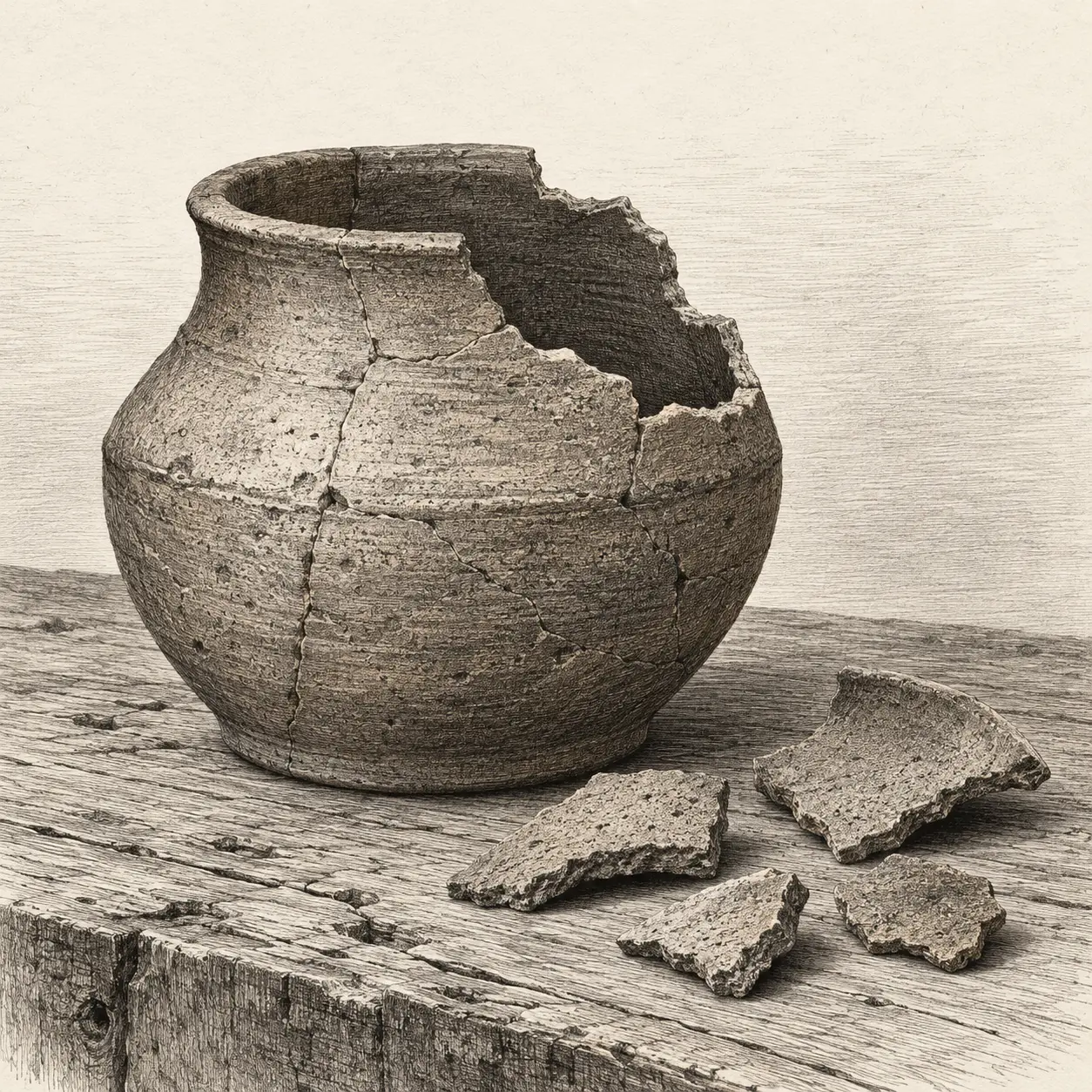
Attested, Reconstructed, Instituted
Because the surviving evidence is incomplete, Fyrnsegen makes careful distinctions between different kinds of religious knowledge and practice.
Some things are attested. They rest upon direct historical evidence: a name preserved in a source, a ritual act described by an observer, a legal custom, a calendrical practice, a word whose meaning is reasonably secure, or an archaeological pattern that can be identified with confidence.
Other things are reconstructed. Here the evidence is indirect or incomplete, but sufficiently coherent to support a reasoned conclusion. Reconstruction may draw upon several kinds of material at once: Old English language and poetry, related Germanic traditions, archaeology, law, folklore, comparative religion, and the internal relationships between surviving practices.
Reconstruction is not guesswork, but neither is it certainty; it should be argued, explained, and open to revision when better evidence appears.
There are also practices that are instituted. No historical religion survives every change of language, society, place, and circumstance without developing new forms. A religious community sometimes requires answers to questions for which the surviving record provides none; where Fyrnsegen has established something for the needs of the present, we say so.
These categories are not rankings of religious worth. An instituted practice is not necessarily less meaningful than an attested one, and an attested custom is not automatically suitable for modern use simply because it is old. The distinction concerns provenance: what do we know about where a practice comes from, and how honestly can we describe it?
Fyrnsegen can therefore be conservative and creative in the proper senses of both words. We preserve what can responsibly be preserved, reconstruct where there is good reason, and institute where religious life requires form that the historical record can no longer supply.
The important thing is not to confuse one category with another.
A Tradition with a Centre
Fyrnsegen belongs to the wider family of modern Heathen religions, but it is not a general Heathenry to which Anglo-Saxon vocabulary has simply been added. It has a particular historical centre, a developing body of theology and practice, and standards governing how inherited material is used.
That centre is the Anglo-Saxon world. Old English provides much of our religious vocabulary; the Anglo-Saxon calendar shapes our reckoning of the year, and Anglo-Saxon sources provide the first point of reference when a question can be approached from more than one direction.
This does not confine Fyrnsegen to English evidence. The surviving Germanic traditions illuminate one another; Old Norse, Gothic, continental Germanic, archaeological, and comparative material may preserve evidence that England has lost. Comparison, however, is not indiscriminate borrowing. Material from elsewhere is most useful when it clarifies a pattern, recovers a distinction, or makes better sense of something already visible in the Anglo-Saxon record.
The same discipline applies to modern practice. Fyrnsegen is not assembled by choosing attractive customs from a range of Pagan religions and placing them beneath an Old English name. Practices are expected to have a reason for being present: because they are attested, because they can be responsibly reconstructed, or because the tradition has consciously instituted them to meet a religious need.
This work has led Fyrnsegen to give considerable attention to theology. Recovering the names of gods or the outward shape of a rite is not enough if we have not asked what kind of world made those things intelligible. Language informs theology; theology informs ritual; ritual stands within sacred time, sacred place, and communal life.
Fyrnsegen is not finished, nor should a religious tradition become static. Its development nevertheless takes place within a recognisable centre.
That is the difference between having sources and having a tradition.
A Living Religion
Fyrnsegen is reconstructive in method, but reconstruction is not its final purpose. The object is not to produce the most convincing model of what an Anglo-Saxon religion might once have looked like; the object is to practice a religion in the present.
Historical evidence can tell us that a custom existed, but religious practice requires another set of questions. What did the custom mean? What relationships did it express? Can it still carry those meanings now? Some things can be taken up again with relatively little difficulty; others belong so completely to the social conditions of another age that imitation would preserve the outward form while losing the substance.
Fyrnsegen is therefore not historical reenactment. We do not attempt to live as Anglo-Saxons, nor regard antiquity as a guarantee of religious value. We live in the modern world and face circumstances our forebears could not have anticipated; a tradition unable to address the conditions in which its people actually live has ceased to function as a tradition.
Adaptation, however, is not licence to make the religion into whatever we might prefer. The inheritance places limits upon us. It gives us a vocabulary, a religious grammar, a pattern of relationships, and a body of practices against which new developments can be judged.
For that reason, Fyrnsegen develops slowly. New ideas must survive examination, practice, and experience before they acquire the weight of custom; what proves sound over time may eventually become part of the tradition received by those who come after us.
This is where reconstruction becomes tradition. What begins as study must eventually be practiced, tested, remembered, and handed on.
Fyrnsegen is not an attempt to return to the past.
It is an attempt to carry something of the past forward without losing its shape.