
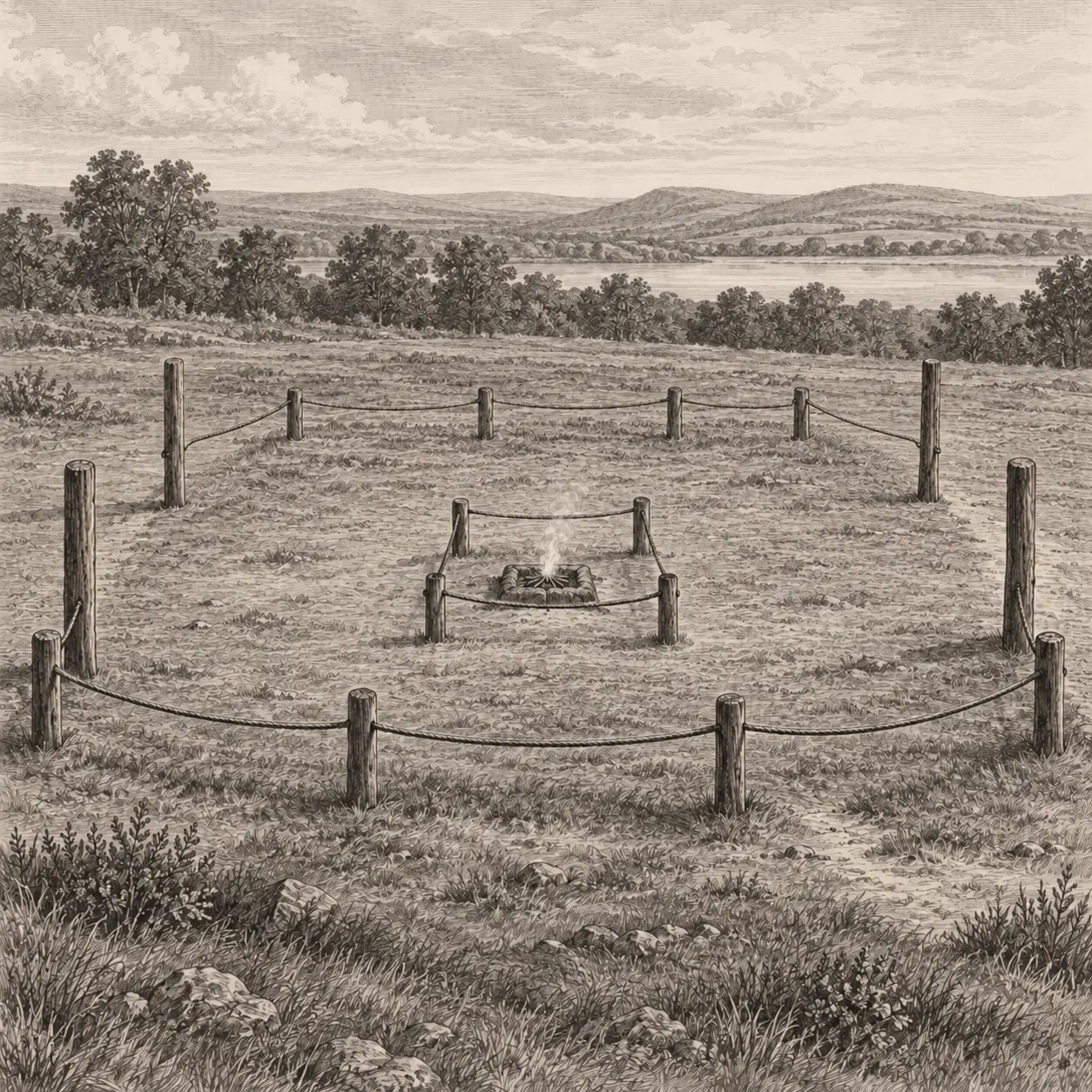
An ealh is not simply a place where worship happens. It is a place ordered for worship; its bounds distinguish it from the weorold, its inner divisions distinguish one condition of sacrality from another, and its measure places the work of men beneath the movements of Sun and Moon. For Fyrnsegen, the ealh comprises two loci joined within one sacred precinct: the hearg, which is hálig, and the wíh, which is wéoh. These are not degrees of a single thing. The wíh is not more hálig than the hearg; the hearg is not weakened wéoh. The distinction is qualitative, and upon it the whole arrangement depends.1
At the centre burns fire. Around the fire lies the wíh; around the wíh lies the hearg. Beyond the heargband lies the weorold. The arrangement is simple enough to mark upon the ground, but it carries several relations at once: mortal and immortal; mundane and sacral; Sun and Moon; fire and field; approach and presence.
The ealh gives these relations a place.
Weorold
The word weorold requires some care. It is not being used here for a "world" in the modern cosmographical sense; we do not mean another planet, a separate plane, or one member of a collection of worlds. We mean the ordinary sphere of mortal life. Old English weoroldlic, with its senses of worldly, temporal, or secular, gives the distinction its proper direction.2
Latin profanus approaches much the same distinction from the sanctuary rather than from ordinary life. It is that which stands pro fano, before or outside the sacred precinct; from this comes the sense of something unconsecrated and belonging to ordinary use.3 The comparison is useful because the words approach the matter from opposite directions. Weoroldlic tells us what belongs to ordinary worldly existence; profanus tells us what lies beyond the sacral boundary.
There is no suggestion that the weorold is evil. Men are born there; they establish households there, work there, feast there, grow old there and die there. It is the proper sphere of ordinary mortal existence. The ealh is established within that sphere, but is not identical with it.
The first visible distinction is the heargband.
Hearg and Hálig
Crossing the heargband from the west brings the worshipper into the hearg. The hearg is the locus of hálig.
Here the folk assemble; here they speak, sing, bring gifts and perform the communal work of worship. Hálig belongs to the sacral condition proper to this place. The hearg is not an antechamber whose only purpose is to keep men away from something "more holy"; it has a positive sacral character of its own.
Old English hālig belongs to a Germanic word-family distinct from the sacral vocabulary represented by Old English wēoh/wīg and Old Norse vé.4 Fyrnsegen retains that distinction rather than translating both indiscriminately as holy. The survival of two vocabularies does not, by itself, furnish the whole theology developed here; it gives us the linguistic ground upon which the distinction can be articulated.
The hearg is hálig.
The boundary of the hearg is the heargband. The term is a Fyrnsegen formation, made in deliberate parallel with wíhband/wéohband and Old Norse vébönd. It names the rope carried between the outer posts of the ealh and marking the extent of the hálig locus. The heargband does not make the ground hálig; neither is it a fence intended simply to exclude. It gives visible form to the boundary between the weorold and the hearg, so that what is ordinarily known as an abstraction can be seen, approached, and crossed.
Unlike the wíhband, the heargband is not opened and closed by a custodian. Its western passage remains open; this is the mortal approach into the ealh. Its eastern passage likewise remains open, but for another reason: it belongs to the divine approach and is not ours to close. The band therefore runs around the remaining bounds of the hearg without sealing either end of the east-west axis. North and south are bounded; east and west are interrupted by their respective portals.5
The two bands consequently perform related but different work. The heargband marks the passage from weorold to hálig; the wíhband marks the passage from hálig to wéoh. The former establishes the visible circumference of the ealh; the latter establishes the inner bounds of the wíh. Neither creates the sacral condition it marks.
At the centre of the hearg stands another bounded place. That place is the wíh.
Wíh and Wéoh
Four posts establish the wíh. Between them runs the wíhband, also called the wéohband; the term deliberately recalls Old Norse vébönd, the sacred cords or bands associated with the bounds of a vé and, particularly, with the consecrated bounds of an assembly.6
Three sides of the wíhband remain fixed. The western side may be opened by the heargweard when his duties require him to enter. His crossing does not make him divine, nor does his office indicate a greater personal measure of sacrality; his work is custodial. He enters because the fire must be tended and the wíh maintained.
The wíh is the locus of wéoh. Again, this does not mean that the wíh is "holier" than the hearg. Wéoh and hálig are qualitatively different; their relationship is one of dependence without identity.
Wéoh is manifest in the fire and maintained within the wíh; the presence of wéoh constitutes the surrounding hearg as hálig.
Wéoh does not diminish until it becomes hálig. Hálig is not wéoh at lower intensity. The presence of the former establishes the condition under which the latter exists; the two remain distinct.
The bands make this distinction visible. They do not create it. A rope cannot make ground sacral merely by enclosing it; rather, the band marks upon the earth the boundary of a condition constituted through rite and maintained through right practice.
Fire
The centre of the wíh is fire.
It would be easy, because the ealh is ordered according to the course of the Sun, to treat the central fire as a representation of the Sun. That is not its principal meaning. The Sun establishes the measure of the ealh; fire establishes its wéoh centre.
Fire may consume corrupted matter without itself becoming corrupted. Disease is destroyed by it; implements and substances may be cleansed through heat; smoke passes over persons and things and is itself used in purification. What enters the flame is altered, while the flame remains fire.
The relation to Thunor belongs here. Lightning is heavenly fire; the Old Norse consecratory formula Þórr vígi preserves Þórr's association with the act of making something sacral. The formula appears on Scandinavian inscriptions and monuments in contexts in which Þórr is called upon to consecrate or protect.7 The Fyrnsegen association does not depend upon making every ritual fire into a representation of Thunor; fire and lightning belong to the same grammar of incorruptible force acting upon what is corruptible.
The fire maintained in the wíh is therefore not merely a useful flame upon an altar. It is the manifest centre of wéoh. From the wéoh fire the wíh receives its character; because wéoh is maintained within the wíh, the surrounding hearg is constituted as hálig.
The Ealh
The ealh is the whole constituted sacred place: hearg and wíh together.
The wíh is the inner locus of wéoh; the hearg is the surrounding locus of hálig. Their ordered conjunction constitutes the ealh.
Weorold — ordinary mortal life
Heargband — outer boundary of the ealh
Hearg — locus of hálig
Wíhband — boundary of the wíh
Wíh — locus of wéoh
Fire — manifestation of wéoh
This is an architecture of distinction rather than exclusion. Mortals belong within the hearg during worship; the wíh nevertheless preserves a condition that is not ordinarily entered. The distinction permits proximity without confusion.
The Mortal and Divine Approaches
The ealh is oriented east and west.
Mortals approach from the west. The west belongs to setting, decline, mortality and death; these are not condemnations of human nature, but acknowledgements of it. Men come before the gods from the condition proper to men: mortal, corruptible, bound to generation and death.
The eastern portal stands opposite the western approach, but it is not a second human entrance. It remains open.
Mortals do not cross it; neither do mortals close it. The east belongs to rising, life, immortality and incorruptibility. The eastern opening is not under human custodianship. It stands as the divine approach.
A worshipper therefore comes from the west, crosses the heargband and enters the hálig hearg. Before him stands the wéoh wíh and its fire; beyond it lies the open east. When the rite is completed, the worshipper returns westward into the weorold. He does not continue through the eastern portal.
The movement establishes a place in which mortal and immortal may meet without either being confused with the other.
Beneath the Open Heaven
The ealh has posts, boundaries, entrances and internal divisions, but it has no roof.
Tacitus gives the clearest early literary comparison. In Germania 9 he says that the Germans did not consider it consonant with the greatness of the heavenly powers to confine the gods within walls or assimilate them to human form; rather, lucos ac nemora consecrant—they consecrated groves and woods.8
The statement does not stand alone. The Semnones assembled in an ancient consecrated grove; Tacitus' Nerthus peoples likewise maintained the goddess's sacred vehicle in a consecrated grove upon an island, attended by a priest who alone perceived when the goddess was present.9 Sacred place did not require a roof before it could possess bounds, restrictions, custodianship and ritual order.
Caesar gives an earlier, if much less developed, observation. He claims that the Germans reckoned among the gods those powers they could perceive and by whose benefits they were manifestly aided; he names the Sun, Vulcanus, and Moon.10 His Vulcanus is Roman interpretation; what matters here is that Caesar understood fire among the immediately perceptible divine powers of German religion.
The conjunction is striking for the ealh. The Sun is visible above it; the Moon is visible above it; fire burns at its centre. These are not three forms of the same thing. The Sun orders the great solar frame; the Moon orders the moving months and appointed full-moon tides; fire manifests wéoh. Yet all three remain visible because the ealh stands beneath the open heaven.
The roof of the ealh is the sky.
Templum, Aedes, and the Bounded Field
Modern English makes such a sanctuary difficult to imagine because temple ordinarily means a building. Roman terminology preserves a useful distinction.
In its technical augural sense, Latin templum was first a delimited space: a portion ritually marked out for observation and sacred action. Varro preserves the augural vocabulary of this delimitation.11 A building belonging to a god could instead be called an aedes, or more explicitly an aedes sacra. The categories could overlap; an aedes might itself possess the technical status of a templum. They were not inherently identical.12
Sacred architecture begins with ordered space, not necessarily with walls. A boundary can be architecture; an axis can be architecture; an opening can be architecture. A field can be architecture.
The ealh therefore lacks neither definition nor structure because it stands open to the sky. Its posts give measure; its bands give visible bounds; its portals order approach; the wíh establishes the centre.
The Roman distinction also returns us to profanus. What lies beyond the sacred precinct lies pro fano; Fyrnsegen calls the ordinary sphere surrounding the ealh the weorold. The correspondence is not lexical identity; each vocabulary nevertheless preserves the distinction between constituted sacred place and ordinary worldly space.
The Measure of the Year
The open heaven matters because Fyrnsegen reckoning is lunisolar. The year is not a sequence imposed upon the sky; the heavens remain authoritative, and the reckoning follows what Sun and Moon actually do.13
Four holy tides establish the great movement of the year:
Geóla — Midnight
Éostre — Dawn
Midsumor — Noon
Wynterfylleð — Dusk
The correspondence joins year and day without making them identical. At Geóla the solar year reaches its depth and turns; at Éostre the year has entered its rising portion. At Midsumor the Sun reaches its height; at Wynterfylleð the year declines toward the winter turning.
The fixed hinge is Geóla.
In the Gerímbóc, Æfter-Géola begins with the first new Moon after the winter solstice; the lunar year is therefore repeatedly brought into relation with the solar turning. The months are lunar, but they do not float free of the Sun.14
Éostre and Wynterfylleð reveal the relation particularly well. Neither is simply "the equinox." Each is observed upon the full Moon of its appointed month. Across the present nineteen-year Micla Géara Hwyrft, the Éostre full Moon ranges from 6 April to 3 May; Wynterfylleð ranges from 9 October to 6 November.15
The holy tide therefore moves while the solar frame remains. The ealh was measured to receive that movement.
The Solar Portals
The present Fyrnsegen ealh measures 45 feet east-west by 39 feet north-south. Reduced to its lowest whole-number proportion, this is 15:13.
The east-west axis passes through the central fire. At the equinoxes the rising Sun stands in the middle of the eastern approach; the setting Sun stands in the middle of the western. As the year moves away from the equinox, sunrise and sunset move north or south along those horizons.
The first form of the field carried the thirteen-foot divisions of the ninefold geometry to the eastern and western boundaries. That produced a thirteen-foot portal. When the actual Éostre and Wynterfylleð dates of the nineteen-year cycle were examined, the lunar holy tides proved to wander too far from the equinox for so narrow an opening to contain every corresponding solar position.
The portal must answer to the heavens rather than to the convenience of the grid.
Across the present Great Cycle, a practical opening of approximately 22½ feet contains the relevant solar movement.16 The number belongs readily to the geometry already present. The centre of a forty-five-foot field lies twenty-two and one-half feet from either eastern or western boundary; the width of the portal therefore equals the distance from the central fire to either end of the east-west axis.
At the equinox, the Sun stands in the middle; at Éostre and Wynterfylleð it moves within the opening. The portal receives the moving holy tide without pretending that a lunar feast is fixed to a solar date.
The four portal posts are consequently governed by solar measure rather than by the thirteen-foot thirds. The inner four posts remain upon the ninefold geometry; the heavens govern the openings through which the principal axis meets the horizon.
Fifteen by Thirteen
The proportion itself emerged from comparative work on sacred architecture.
The great outer measure of Angkor Wat is commonly described at approximately 1,500 metres east-west by 1,300 metres north-south; taken as a convenient whole-number relation, this is 15:13.17 The use of that proportion here does not depend upon claiming that Khmer builders expressed Angkor Wat through the reduced integers 15 and 13. The approximate relation furnished a starting geometry; its usefulness became apparent when the rectangle was turned toward the Sun and examined as an open field.
Scaled by three, the relation gives 45 × 39 feet. Divided into thirds upon both axes, it gives nine rectangles of 15 × 13 feet each. The central rectangle is thereby generated without further adjustment; its four corners establish the four inner posts, and within those posts stands the wíh.
The ninefold division therefore existed first as geometry before a symbolic explanation was imposed upon it. Nine is too important within Germanic tradition to be ignored; it is also too important to be invoked lazily. The meaning of the nine fields requires treatment in its own right.
The Ara Pacis
The Ara Pacis Augustae provides a useful comparison in another direction.
Its marble precinct is a modest rectangle, approximately 11.6 by 10.6 metres, with opposed openings and a sacrificial altar within.18 Its proportion is not 15:13; what matters here is the architectural grammar of bounded sacred ground, axial approach and an internal sacrificial locus.
The Ara Pacis establishes a defined ritual precinct through a marble screen; the Fyrnsegen ealh establishes one through posts and bands. In each, the ritual centre is distinguished from the ordinary ground surrounding it; in each, approach and centre are made architecturally legible.
Arkona
Arkona brings the comparison nearer to northern European cult practice.
Saxo's description of the sanctuary of Svantevit gives an outer temple containing an inner enclosure supported upon four posts; hangings occupied the place of solid walls around the innermost space.19 The four-post arrangement is particularly suggestive beside the four posts surrounding the Fyrnsegen wíh. In both cases an inner sacral locus is materially distinguished within a larger sacred complex.
The ground surrounding the Arkona sanctuary is equally important. Schuchhardt's early excavation described a broad Festplatz around what he interpreted as the temple and remarked upon the unusual scarcity of ordinary settlement debris there when compared with the inhabited portion of the fortress.20 Later excavations altered his reconstruction substantially and rejected his identification of the approximately twenty-by-twenty-metre foundations as the late temple; nevertheless, the later work continued to distinguish prepared cult ground from ordinary habitation and placed the sanctuary nearer the portion of the cape subsequently lost to erosion.21
Arkona consequently gives us more than a temple building. It gives us differentiated sacred ground; within the cult complex stood a more restricted locus, and within Saxo's temple description stood the four-post inner enclosure.
The comparison with the ealh is therefore productive: the whole precinct contains the hálig hearg; within the hearg stands the wéoh wíh; at the centre stands the fire.
The Bands and the Field
The Fyrnsegen ealh makes its boundaries with rope.
The heargband runs along the outer posts, but the western approach remains open. A worshipper does not need the band lifted to enter the hearg; the mortal way into the ealh is structurally present. The eastern opening likewise remains open, though it is not crossed by mortals. It is not a door controlled by the heargweard; human beings have no office by which to close the divine approach.
The wíhband is different. Its northern, eastern and southern sides remain fixed; its western side can be opened when the heargweard must enter the wíh. The two bands therefore do not merely repeat one another at different scales. The heargband orders the relationship between weorold and hálig; the wíhband orders the relationship between hálig and wéoh.
The posts themselves give the field vertical measure. The outer corner and intermediate posts establish the body of the ealh; the portal posts rise higher, making the east-west openings visible even at a distance; the four inner posts mark the wíh without turning it into a house. Timber, rope, earth and fire are enough.
Measure, Fire, and Turning
The several parts of the ealh can now be read together.
Its measure is solar. The east-west axis receives sunrise and sunset; the widened portals receive the wandering solar positions associated with the lunar tides of Éostre and Wynterfylleð. Geóla fixes the winter turning upon which the lunar reckoning depends; Midsumor stands opposite it at the height of the year.
Its centre is wéoh. Fire burns within the wíh; the wíh is bounded by the wíhband and entered from the west only when custody requires it.
Its surrounding sacred ground is hálig. The hearg receives the folk; the heargband distinguishes that locus from the weorold without making the mundane world evil or alien.
Its approach is mortal. Men come from the west and return westward. The east remains open; the divine approach is not ours to shut.
Its roof is the heaven. Sun and Moon remain visible; the reckoning by which sacred time is known remains before the eyes of those who keep it.
The ealh is therefore neither a diagram laid upon worship nor a building emptied of walls. It is an ordered field in which the distinctions already fundamental to Fyrnsegen are given form. Weorold, hálig and wéoh are not abstractions once the bands are strung; west and east are not merely directions once men approach from one and leave the other uncrossed; the relation of Sun and Moon is not merely calendrical once their movement can be watched from the central fire.
The ealh gives sacred order a body.
Its ninefold division remains to be considered. That question should begin where the present one ends: not with the observation that Germanic tradition favours the number nine, but with the fact that the geometry produces one central field surrounded by eight others. Whether that structure can be shown to belong to a wider Germanic grammar of ninefold order is a question for separate treatment.
For now the first principle is enough.
The ealh is hearg and wíh together; the hearg is the locus of hálig, the wíh the locus of wéoh. Wéoh is manifest in the fire and maintained within the wíh; its presence constitutes the surrounding hearg as hálig. Around both lies the weorold; above both turn Sun and Moon.
In measure and in season; in fire and in turning, the ealh is kept.
Notes
The precise Fyrnsegen distinction between hálig and wéoh, and between hearg and wíh as their respective loci, is a theological development within the tradition. It draws upon distinct Germanic sacral vocabularies without claiming that surviving Old English texts set out this complete system in these terms. See notes 4 and 5. ↩ Return
Joseph Bosworth and T. Northcote Toller, An Anglo-Saxon Dictionary, s.v. "woruld-líc," with the senses "worldly" and "secular"; compare the related entries for woruld/weorold. The Fyrnsegen technical use of weorold denotes the mundane sphere surrounding the ealh, not a separate cosmological "world" in the modern sense. ↩ Return
Charlton T. Lewis and Charles Short, A Latin Dictionary, s.v. "profānus," from pro and fanum: that which is before or outside the sacred precinct, hence unconsecrated or profane. Weoroldlic and profanus are compared here conceptually, not offered as philological equivalents. ↩ Return
Bosworth and Toller, An Anglo-Saxon Dictionary, s.vv. "hālig," "wēoh," and "wīg"; Vladimir Orel, A Handbook of Germanic Etymology (Leiden: Brill, 2003), relevant entries for the Germanic sacral word-families; Jan de Vries, Altnordisches etymologisches Wörterbuch, 2nd ed. (Leiden: Brill, 1962), s.v. "vé." The existence of distinct lexical families supplies evidence for distinct sacral vocabulary; the exact Fyrnsegen theological relation developed in this paper is constructive rather than a claim about a formal Anglo-Saxon doctrinal taxonomy. ↩ Return
Heargband is a Fyrnsegen formation combining Old English hearg, the term used here for the outer cultic locus, with band. It is formed deliberately in parallel with wíhband/wéohband and Old Norse vébönd, but heargband is not presented as an attested Old English compound. Its function within Fyrnsegen terminology is specific: it denotes the band marking the boundary between the weorold and the hálig hearg. Compare Bosworth and Toller, An Anglo-Saxon Dictionary, s.v. hearg, and Cleasby and Vigfússon, An Icelandic-English Dictionary, s.v. vé-bönd. ↩ Return
Richard Cleasby and Guðbrandur Vigfússon, An Icelandic-English Dictionary (Oxford: Clarendon Press, 1874), s.v. "vé-bönd," "the sacred cords," especially in relation to the consecrated bounds of the assembly; compare vé, sanctuary or sacred place. Wíhband/wéohband is a Fyrnsegen formation using the cognate Old English sacral vocabulary; it is not presented as an independently attested Anglo-Saxon technical term. ↩ Return
For the Scandinavian consecratory formula Þórr vígi and related inscriptions, see Mindy MacLeod and Bernard Mees, Runic Amulets and Magic Objects (Woodbridge: Boydell Press, 2006), 27–31 and passim; compare the Velanda and Glavendrup inscriptions and other invocations of Þórr to consecrate or protect. ↩ Return
Tacitus, Germania 9: ceterum nec cohibere parietibus deos neque in ullam humani oris speciem adsimulare ex magnitudine caelestium arbitrantur: lucos ac nemora consecrant... See J. B. Rives, trans. and comm., Tacitus: Germania (Oxford: Clarendon Press, 1999), 78–79. ↩ Return
Tacitus, Germania 39, on the Semnonian grove, and 40, on Nerthus and the consecrated grove. See Rives, Tacitus: Germania, 97–100, 292–303. ↩ Return
Caesar, De Bello Gallico 6.21: Deorum numero eos solos ducunt, quos cernunt et quorum aperte opibus iuvantur, Solem et Vulcanum et Lunam... See H. J. Edwards, trans., Caesar: The Gallic War, Loeb Classical Library 72 (Cambridge, MA: Harvard University Press, 1917), 338–39. Caesar's Vulcanus is interpretatio Romana and is treated here as his identification of fire among the powers he believed the Germans worshipped. ↩ Return
Varro, De Lingua Latina 7.8–10, preserving augural language concerning the delimitation of the templum. See Roland G. Kent, trans., Varro: On the Latin Language, vol. 2, Loeb Classical Library 334 (Cambridge, MA: Harvard University Press, 1938), 276–83. ↩ Return
Mary Beard, John North, and Simon Price, Religions of Rome, vol. 1 (Cambridge: Cambridge University Press, 1998), 22–23; John Scheid, An Introduction to Roman Religion, trans. Janet Lloyd (Bloomington: Indiana University Press, 2003), 62–63. Roman usage is not reducible to a simple equation in which templum always means field and aedes always means building; the useful distinction is that technical templum status depended upon ritual delimitation and was not synonymous with "building." ↩ Return
Brian Smith, The Gerímbóc and the Seasons (Baltimore, MD: Fyrnsegen Press, 2026), "The Long Drift of the Great Year Cycle": "The heavens remain authoritative; the cycle is only the memory-aid." The reckoning is explicitly observational; tabular calculation remains subordinate to observed Sun and Moon. ↩ Return
Smith, The Gerímbóc and the Seasons, on the rule that Æfter-Géola begins with the lunar renewal following the winter solstice. In the 2033 trial case, the last new Moon before or upon the solstice belongs to Ærre-Géola; Æfter-Géola follows with the next renewal. ↩ Return
Smith, The Gerímbóc and the Seasons, Appendix I, "Great Cycle Month Tables, 2017–2035." Across the present cycle the Éosturmónað full Moon ranges from 6 April (2023) to 3 May (2034); the Winterfylleð full Moon ranges from 9 October (2022) to 6 November (2033). ↩ Return
Fyrnsegen working calculation based upon the nineteen Éostre and nineteen Wynterfylleð full-Moon dates in Smith, The Gerímbóc and the Seasons, Appendix I. At the London working latitude used in development of the field, the greatest relevant solar displacement over the cycle requires an opening of approximately 22.5 feet when viewed from the centre of a 45-foot east-west field. The dimension is intentionally practical rather than surveying-level astronomical precision. ↩ Return
Eleanor Mannikka, Angkor Wat: Time, Space, and Kingship (Honolulu: University of Hawai'i Press, 1996), on the measures, orientation, and numerical organization of Angkor Wat. Modern descriptions commonly round the outer complex and moat to approximately 1,500 × 1,300 metres. The reduced 15:13 relation is used here as a design abstraction from those approximate dimensions, not attributed to Khmer builders as an explicitly stated canonical ratio. ↩ Return
Giuseppe Moretti, Ara Pacis Augustae (Rome: Libreria dello Stato, 1948), architectural plans and plates; Diane Atnally Conlin, The Artists of the Ara Pacis (Chapel Hill: University of North Carolina Press, 1997). The reconstructed enclosure is approximately 11.6 × 10.6 metres, with opposed axial openings and the altar contained within the precinct. ↩ Return
Saxo Grammaticus, Gesta Danorum 14.39, describing the sanctuary of Svantevit at Arkona and the inner enclosure supported by four posts with hangings in place of walls. See Karsten Friis-Jensen, ed., and Peter Fisher, trans., Saxo Grammaticus: Gesta Danorum, The History of the Danes, vol. 2 (Oxford: Clarendon Press, 2015), 1296–99. ↩ Return
Carl Schuchhardt, Arkona, Rethra, Vineta: Ortsuntersuchungen und Ausgrabungen, 2nd rev. ed. (Berlin: Schoetz, 1926), discussion and plans of Arkona. Schuchhardt described the Festplatz as extending broadly around what he interpreted as the temple and contrasted its scarcity of ordinary finds with the occupied areas of the fortress. ↩ Return
Later investigations of Arkona in 1969–71 revised Schuchhardt's interpretation, treating his supposed temple foundations as part of an earlier fortification and placing the late cult locus nearer the eroded cliff. See Joachim Herrmann, ed., Die Slawen in Deutschland: Geschichte und Kultur der slawischen Stämme westlich von Oder und Neiße vom 6. bis 12. Jahrhundert (Berlin: Akademie-Verlag, 1985), together with the published reports of the Arkona investigations. The changing reconstruction does not erase the archaeological distinction between prepared cult ground and ordinary habitation. ↩ Return
Bibliography
Beard, Mary, John North, and Simon Price. Religions of Rome. Vol. 1. Cambridge: Cambridge University Press, 1998.
Bosworth, Joseph, and T. Northcote Toller. An Anglo-Saxon Dictionary. Oxford: Oxford University Press, 1898; supplement 1921.
Caesar. The Gallic War. Translated by H. J. Edwards. Loeb Classical Library 72. Cambridge, MA: Harvard University Press, 1917.
Cleasby, Richard, and Guðbrandur Vigfússon. An Icelandic-English Dictionary. Oxford: Clarendon Press, 1874.
Conlin, Diane Atnally. The Artists of the Ara Pacis: The Process of Hellenization in Roman Relief Sculpture. Chapel Hill: University of North Carolina Press, 1997.
de Vries, Jan. Altnordisches etymologisches Wörterbuch. 2nd ed. Leiden: Brill, 1962.
Friis-Jensen, Karsten, ed. Saxo Grammaticus: Gesta Danorum, The History of the Danes. Translated by Peter Fisher. 2 vols. Oxford: Clarendon Press, 2015.
Herrmann, Joachim, ed. Die Slawen in Deutschland: Geschichte und Kultur der slawischen Stämme westlich von Oder und Neiße vom 6. bis 12. Jahrhundert. Berlin: Akademie-Verlag, 1985.
Lewis, Charlton T., and Charles Short. A Latin Dictionary. Oxford: Clarendon Press, 1879.
MacLeod, Mindy, and Bernard Mees. Runic Amulets and Magic Objects. Woodbridge: Boydell Press, 2006.
Mannikka, Eleanor. Angkor Wat: Time, Space, and Kingship. Honolulu: University of Hawai'i Press, 1996.
Moretti, Giuseppe. Ara Pacis Augustae. Rome: Libreria dello Stato, 1948.
Orel, Vladimir. A Handbook of Germanic Etymology. Leiden: Brill, 2003.
Rives, J. B., trans. and comm. Tacitus: Germania. Oxford: Clarendon Press, 1999.
Scheid, John. An Introduction to Roman Religion. Translated by Janet Lloyd. Bloomington: Indiana University Press, 2003.
Schuchhardt, Carl. Arkona, Rethra, Vineta: Ortsuntersuchungen und Ausgrabungen. 2nd rev. ed. Berlin: Schoetz, 1926.
Smith, Brian. The Gerímbóc and the Seasons. Baltimore, MD: Fyrnsegen Press, 2026.
Tacitus. Germania. In Rives, Tacitus: Germania. Oxford: Clarendon Press, 1999.
Varro. On the Latin Language. Vol. 2. Translated by Roland G. Kent. Loeb Classical Library 334. Cambridge, MA: Harvard University Press, 1938.