
Worship & sacred order
Sacral Kingship
Kingship as sacral office: grounded in a folk, bounded by right order, answerable for land and prosperity, and presently unrealised within Fyrnsegen.
The Sacred Office
Fyrnsegen affirms sacral kingship, but it does not manufacture kings.
Kingship, in the Fyrnsegen understanding, is more than a form of government. The cyning occupies a sacred office at the meeting-place of gods, folk, land, custom, and right order; he is not simply the chief administrator of a community, nor merely its most powerful man. In the ideal expression of the office, the king bears obligations that reach beyond himself and beyond the ordinary work of leadership.
John Boorman’s Excalibur (1981) gives this burden a memorable dramatic form. Arthur receives a sword and an office; he must still learn what each requires of him. The film belongs to modern Arthurian storytelling, yet its questions are also ours: what makes a king worthy of his authority, what does he owe the world gathered around him, and what happens when the man fails the office?
The king stands as a sacral bridge between the folk and the gods. Through him should flow and gather luck, mægen, and frofur: the good fortune, strength, and sustaining help by which both people and land flourish. His worth is therefore not measured simply by his ability to command, but by what grows around him: peace among the people, strength in the community, increase in field and herd, the keeping of law and custom, and the ability of the folk to endure when hardship comes.
This does not mean that a king magically controls weather, harvest, prosperity, or fate. It means that kingship places the ruler within a sacred network of responsibility; the condition of the king, the condition of the folk, and the condition of the land cannot finally be treated as unrelated things.
This is also why a king can fail. The failure of a particular king does not invalidate kingship; rather, the possibility of failure demonstrates that kingship possesses obligations independent of the man who occupies the office. A king may cease to be worthy of what he bears. The king may fail. Kingship does not.
Fyrnsegen therefore recognises sacral kingship as part of the sacred architecture inherited from the Germanic world. Recognising kingship, however, is not the same thing as pretending to possess it.
Here sacral does not name one fixed constitution shared unchanged by every Germanic people. Nor does it require a king to be a god, an incarnate deity, or the priest of every rite. It names a condition in which kingship participates in the sacred relations of a community and therefore bears obligations that cannot be reduced to warfare, taxation, and administration.
The surviving evidence allows divine ancestry, favour from the gods, ritual obligation, public cult, prosperity, and posthumous honour to meet around rulers; it does not allow us to treat those things as identical. An ancestral claim is not living divinity. Participation in sacrifice is not a monopoly upon priesthood. Prosperity may be a responsibility, a representation, a sign, or a consequence without being an occult substance in the king’s body.
The sacredness of the king is therefore found less in some mysterious quality lifting him beyond ordinary obligation than in the density of the obligations gathering around him. The king stands more deeply inside the order, not outside it.
First the Folk
A cyning does not create a folk by declaring one into existence. Kingship arises within an order already made real through kin, community, custom, land, and obligation. The crown does not supply the human and historical substance of the kingdom; it gathers relations that already possess enough life to be gathered.
The older vocabulary of lordship helps to make the distinction plain. A dryhten is known through the following gathered around him, while a þéoden is named in relation to a þéod, a people. One man may be both, but a retinue is not the same social body as a folk. The members of a following may be bound closely to their lord by service, gift, oath, household, and personal loyalty. A folk also contains children, households, kindreds, cultivators, ritual specialists, local leaders, the old, the infirm, neighbours, and many who will never stand within the king’s immediate company.
The ruler of a retinue does not therefore become ruler of a folk merely by increasing the number of people who swear personally to him. A genuine lordship may stand without being an unfinished kingship; a household, sacred precinct, military following, and people each place different obligations upon those who bear authority within them.
Historical kingship likewise cannot be reduced either to automatic inheritance or to a modern election. Royal descent often narrowed the field of possible claimants, yet birth alone did not make rule effective. Recognition might be expressed through assembly, acclamation, oath, counsel, military support, acceptance by leading households, or the absence of an effective rival. The point is not that each person voted. It is that no man could make himself king by self-assertion alone.
A useful sequence is eligibility, designation, recognition, accession, and performance. It is not a universal rite or constitutional formula. It keeps distinct the questions that the evidence keeps distinct: why a man may plausibly claim the office; how one claim is preferred; who must acknowledge it; how that relation becomes publicly established; and what the king does after receiving it.
Royal ancestry enters at the beginning of this relation, not its conclusion. A house descended from Wóden, Freyr, or another divine or heroic ancestor could possess a sacred depth unavailable to an unrelated claimant. Yet inheritance is condition, not achievement. The heir receives land, alliances, enemies, obligations, reputation, and comparison with the dead; he does not inherit their courage or perform their deeds again merely by bearing their blood.
This also prevents hierarchy from becoming a measure of human worth. Office differentiates responsibility according to relation and capacity. A king’s greater authority does not make him a greater kind of human being; it increases what may rightly be asked of him and how many lives his conduct can affect.
This is the meaning of First the Folk. It is not a democratic slogan. It does not mean that a folk has no hierarchy, or that every person must give individual consent before authority can be real. It means that kingship answers a larger social body which it did not create from nothing.
Titles cannot supply what that order lacks. A crown assumed by private desire, or an office invented to complete the outward appearance of tradition, does not restore sacral kingship. First there must be a folk whose life is capable of sustaining the office and whose inherited order gives it meaning.
Cult, Hall, and Gift
Sacral kingship does not require the king to absorb every religious office into himself. Tacitus distinguished kings from priests. Ammianus did the same among the Burgundians. Bede remembered Coifi as chief priest of Edwin’s old religion rather than treating Edwin himself as the natural holder of that office. The absence of a universal priest-king does not make rulership secular; it shows that sacred responsibility could be differentiated by office.
Kings nevertheless stood within public religion in ways a private worshipper did not. Rædwald’s accommodation of old and new cult belonged to a royal religious establishment. Traditions concerning Hákon the Good and the Swedish king Anund preserve a sharper conflict: subjects expected the ruler to participate in inherited sacrifice, and a king’s private conviction did not necessarily release him from what the people believed his office required. The exact rites and source histories differ, but the structure is durable. The king need not be priest of every cultic act for there to be religious deeds proper to kingship.
This point matters because sacred office constrains before it exalts. The ruler may have to protect a sanctuary, maintain a feast, honour inherited cult, receive an omen, occupy a particular seat, or take part in acts undertaken for the wider folk. Sacrality places the king under obligation before it gives him control.
The great hall and royal centre make that obligation material. At places such as Yeavering, Rendlesham, Tissø, Uppåkra, Lejre, and Gamla Uppsala, elite residence could stand beside assembly, feast, craft, exchange, burial, and cult. These sites were not identical institutions, and archaeology cannot recover a complete theology from posts and deposits. They show something simpler: rulership, hospitality, judgement, memory, economy, and sacred action could gather within the same landscape.
The king’s part may therefore be understood partly as that of a sacral host. This is Fyrnsegen’s analytical description, not an attested ancient title. The ruler provides and protects the place of gathering, bears costs, receives persons under his peace, participates as custom requires, and makes feast and worship part of a durable relation. Priests and other specialists retain their own responsibilities; the king is not a spectator simply because another hand performs the sacrifice.
Gift belongs to the same movement. Wealth travels inward through tribute, render, labour, land, and service, then outward through protection, hospitality, reward, relief, patronage, and public action. The king receives more because more must pass through his hands. The ring, weapon, land-grant, or place at table does not merely display wealth; it recognises service, establishes expectation, and becomes evidence of a relation before witnesses and descendants.
Generosity does not judge itself. A magnificent feast paid for by ruinous exaction can glorify the centre while consuming the folk that sustains it. A gift may reward fidelity or purchase complicity. Sacred display does not excuse the source of the wealth, the terms upon which it was taken, or the people excluded from its benefit.
The good host is therefore not measured by splendour alone. Hall, gift, and feast must perform provision, protection, recognition, worship, and the renewal of legitimate obligations. A hall that consumes the folk for the glory of its lord has reversed the relation it was meant to sustain.
The King under Riht
Kingship does not stand outside riht. If anything, the concentration of power in the king makes the distinction between authority and right order more important. Old English can speak of a riht cyning: not merely a man possessing the title, but one whose standing and conduct may be described as rightful, fitting, or true to the office. Kingship is capable of being measured.
That measure should not be turned into a modern constitution and read backwards into the past. The evidence is more practical. Kings inherit custom, receive counsel, issue judgements, maintain peace, lead armies, gather and distribute wealth, and answer expectations they did not personally invent. When those deeds are praised or condemned, the king is being compared with something other than his own will.
Alfred’s account of his law-book provides a later Christian example. He selected from earlier judgements, altered some with the counsel of his witan, and hesitated to set down too much of his own because he could not know what later generations would find fitting. He acts powerfully, but not as though personal desire creates riht. Lawgiving appears as inheritance, judgement, counsel, amendment, and responsibility for what others will receive.
The coronation promises of Christian Anglo-Saxon kings make the same structure unusually explicit. Their theology is Christian and must not be passed off as an unchanged pagan rite, yet they show what happens when royal sacrality is openly articulated: the consecrated king is bound to peace, the restraint of robbery and unriht, and justice joined with mercy. Sacred office comes burdened with promises.
The distinction applies to command as well. A lord’s order does not become right merely because obedience is ordinarily due to a lord. The king acts through messengers, officers, judges, warriors, households, and scribes; his word can therefore become the deed of many people. That distributed action enlarges his reach without dissolving anyone’s agency.
At Camelot, Arthur asks Merlin which quality is greatest in knighthood. Merlin first speaks of virtues blended like the metals of a sword; pressed for a straight answer, he names truth.
“It must be truth above all. When a man lies, he murders some part of the world.”
— Merlin, Excalibur (1981)
Merlin is answering a question about knights; the force of his answer reaches further in the king. Courage can serve a crooked cause; loyalty can shelter a falsehood; generosity can purchase silence. Truth gives those powers something sound upon which to act. A ruler must be able to distinguish what has happened from what he wishes had happened, and those who depend upon his word must be able to do the same.
In Fyrnsegen terms, the scene touches both Sōþ and Trēowþ: what is so, and the fidelity by which a person can be relied upon. A royal lie may become a false accusation, an unlawful seizure, a broken peace, or the remembered pretext for war. It gives error the means to become other people’s deeds; they must then inhabit the consequences. A king’s truthfulness belongs among the conditions by which the common world is kept.
Office changes the credible answer to the question, “What could you have done?” A private person with little power cannot be judged as though he commanded a treasury, courts, roads, armed force, and officials. A king who possesses those capacities stands differently. His mægen makes possible glory in protection and judgement; it also makes neglect and misuse consequential on a scale unavailable to the private person.
Sacrality cannot provide immunity from that measure. It adds another relation capable of being betrayed. A ruler who turns private ambition into divine necessity, imposes oaths he treats as ornamental when they bind him, or makes cult a shield against judgement violates the sacred office rather than defending it.
The king is therefore neither the source of riht nor a passive servant without authority. He stands inside an inherited order with unusual power to preserve, damage, and reshape what the folk will pass onward.
The Empty Throne
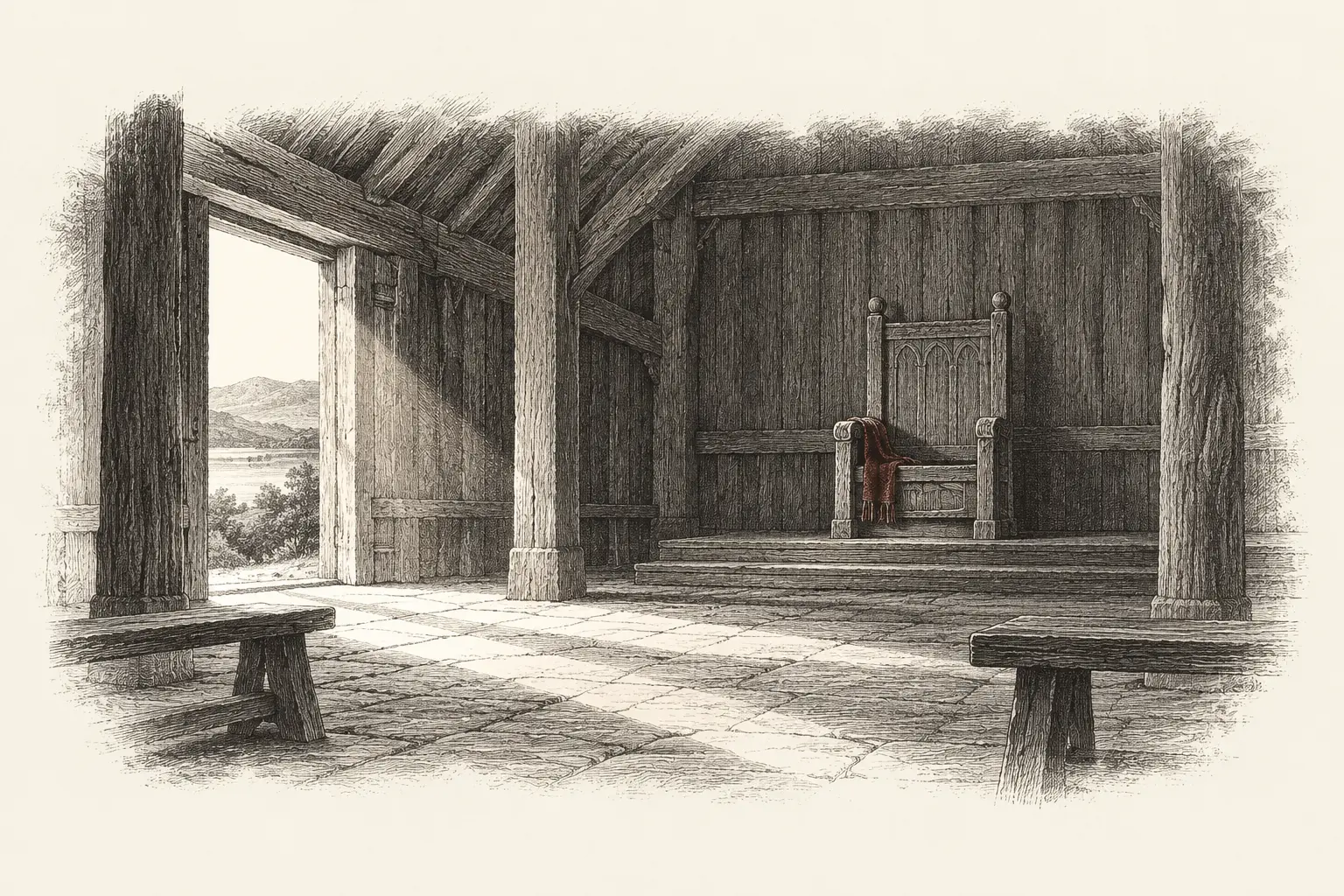
This distinction is given visible form in the Fyrnsegen custom of the empty throne.
At gatherings of the cynn there may stand a fealdestōl, a folding campaign-chair constructed so that its back may be removed. In its complete form, with the back fitted in place, it is the cynesetl, the king’s seat; until there is a king, it remains empty.
When the back is removed, however, the same chair may serve as the dōmsetl, the seat of the cynn’s recognised leader. In this form it is deliberately incomplete. It has neither sethrægl, the cushion of the seat, nor hlinung, the support of the back, nor fōt-setl, a footstool.
Each absence is intentional.
The seat of leadership should not be comfortable to one who is not a king; leadership is duty before it is privilege. The bare seat reminds its occupant that authority carries burden and obligation.
The leader is likewise given no back upon which to rest. The office offers no special support merely because one has been entrusted with leadership; a leader must remain upright by his own worth, sustained by right conduct and by the confidence of the cynn.
Nor is there a footstool beneath him. The leader remains grounded among the folk; he does not rise above them merely because he leads them. The king occupies another relationship altogether.
Thus the same physical object may be either stool or throne, but the distinction is not cosmetic. The back, cushion, and footstool mark the boundary between ordinary leadership and sacral kingship. The cynesetl belongs to the king and to the king alone; when there is no king, the throne remains empty.
This is not an attested custom of the ancient Germanic peoples. It is an instituted Fyrnsegen practice: a modern ritual form consciously created to express the tradition’s understanding of leadership, kingship, and sacred order.
The empty throne therefore does not signify that Fyrnsegen lacks something it ought hurriedly to acquire; it signifies restraint.
It says, in material form, that the office is real enough that we will not counterfeit it.
The King and the Land Are One
There is another reason Fyrnsegen remains reticent about attempting to establish sacral kingship in the present day: a king requires more than a folk. He requires a land.
Boorman makes the relation visible in Arthur’s wasting and the desolation of his realm. When Perceval brings the Grail, he names the bond the king has forgotten: “You and the land are one.” The restoration of Arthur and the renewal of the land belong to a single movement.
Land here is not merely territory enclosed by a boundary. It is the material condition of communal life: field and pasture, woodland and water, road and settlement, grave and holy place, assembly and remembered centre. It is worked, inherited, altered, and named across generations. The wealth of the hall, the food of the feast, the maintenance of households, and the ability of the folk to endure all arise from relations rooted there.
The king, the folk, and the land therefore form a triangle of obligation. The people work, remember, worship upon, and receive sustenance from the land. The king gathers resources and authority from both people and place, then owes protection, judgement, peace, right distribution, and the keeping of the sacred relations that allow both to flourish. The land is not a possession lying inert beneath royal will; it is one of the relations through which kingship becomes meaningful.
This is the deeper sense in which luck, mægen, and frofur should gather through the king. He does not contain a magical substance that makes grain grow. His office places military, legal, economic, religious, and social capacities where they can affect the life of the whole. Secure fields, restrained predation, passable roads, settled disputes, predictable burdens, maintained worship, wise storage, and protected exchange all become part of the fortune of a reign.
Weather, disease, enemies, and the gods remain beyond command. Responsibility does not require omnipotence. A bad harvest is not automatic proof of a bad king, just as one victory is not proof of righteousness. Yet the condition of the realm cannot be treated as irrelevant to an office whose decisions determine how well the folk can answer hardship.
The older association of rulership with ár and frið—good season and peace—belongs here. Good season without peace leaves harvest open to seizure; peace without production leaves people secure enough to starve. Together they name the quieter prosperity within which households sow, trade, marry, worship, raise children, and expect that their work will reach another year. A king fortunate in peace may leave more worth inheriting than one remembered only for continual victory.
Land also holds Wyrd in visible form. Earlier deeds remain in boundary, field, grave, road, ruined hall, cleared wood, grant, and sanctuary. The king receives that inheritance; he does not make its history begin at accession. His grants can change households for generations, his wars can burn settlements, his peace can permit rebuilding, and his patronage can gather worship and memory around a place. What he does becomes part of what later people must inhabit.
The relation therefore concerns use, not an untouched landscape. Germanic peoples cultivated, grazed, hunted, fortified, mined, built, and changed the ground around them. The measure is whether use destroys the relation upon which later life depends. A king who strips the land for short-term glory, exhausts dependent households, or turns endemic dispute into the ordinary condition of cultivation consumes the foundation of his own authority.
Royal power may gather around places already sacred or politically meaningful. The king does not necessarily make the centre any more than he makes the folk. He inherits it, occupies it, reshapes it, and becomes answerable for what his reign leaves there.
To say that king and land are one is therefore not to claim that the ruler’s body magically controls the earth. It is to say that sacral kingship joins the condition of ruler, folk, and inhabited ground so closely that none can finally be judged in isolation. The land does not obey simply because the king commands it. It answers in consequence.
The King May Fail; Kingship Does Not
The distinction between king and kingship becomes clearest when they cease to fit comfortably together. A man may possess royal blood yet lose recognition; he may be properly received and later govern crookedly; he may retain the title while losing the capacity to carry its obligations; or private desire may bring him into conflict with rites, laws, and expectations attached to the office.
Merlin’s warning about fear belongs beside this. He tells Arthur that a king should remain afraid of the enemy; he names the castle corridors and forest paths before turning to the more tangled forest within the king himself. A ruler may guard every road to his hall and still admit ruin through vanity, resentment, appetite, or the wish to be flattered.
That inward watchfulness requires other people. Counsel becomes useless when the king permits only agreement; a witness cannot correct him if unwelcome truth is punished. The ruler who wishes to remain answerable must leave others room to speak. He must learn when the danger lies in the enemy before him, and when it lies in his own wish to have an enemy.
The evidence gives no single Germanic procedure for answering these failures. Kingship was not a temporary commission held at the pleasure of an electorate, and a ruler might survive defeat, opposition, and poor judgement for a long time. Durability, however, is not unconditionality. Sigeberht could be deprived of much of his West Saxon kingdom for what the Anglo-Saxon Chronicle calls unrighteous deeds. Gothic rulers could be replaced when defence failed. Burgundian kingship could be judged through military and agricultural failure. In Scandinavian conversion narratives, refusal of public cult could become a dispute about whether a particular king would continue to bear the office.
These sources are partial, interested, and separated by place and time. None should become a universal constitution. Together they show that people could appeal to kingship against the king. Removal of a ruler need not reject the office; it may be an attempt to preserve the relation by changing its holder.
Success and fitness must likewise remain distinct. A man may be skilled at keeping a throne and bad at kingship. He may destroy rivals, reward a narrow following, silence counsel, and gather wealth efficiently while damaging the wider peace. Another ruler may act fittingly and still lose through stronger enemies, famine, disease, or mischance. Consequences matter because kingship is an office of consequence; they still require judgement.
Personal loyalty cannot supply the whole measure. The king rules many who never enter his hall or receive a gift from his hand. If he reduces the realm to those personally loyal to him, he confuses the dryht with the þéod. Favour shown to companions becomes corruption when it removes them from the law and protection owed to the rest of the folk.
Nor does sacredness make failure impossible. It makes failure weightier. The more relations entrusted to the office—cult, peace, judgement, land, gift, oath, memory—the more relations its holder can betray.
The king may fail. Kingship does not.
This does not mean that every historical form of kingship is incapable of corruption. Institutions can become crooked too. It means something narrower and more demanding: the bad deed of a king does not redefine the purpose of kingship merely because royal power made the deed effective. The distinction preserves the measure by which a king can be judged. If kingship meant nothing more than whatever a ruler happened to do, it could supply no standard beyond power itself.
A Dream to Some
When Arthur encounters Merlin again in Boorman’s Excalibur, he asks whether the magician is a dream. Merlin’s answer holds both possibilities: “A dream to some. A nightmare to others.” He is speaking of himself; the phrase can also name the divided response awakened by sacral kingship.
Sacred order, a ruler bound to folk and land, judgement under riht, peace made wider than one household, and public office carrying blessing rather than private appetite can present a compelling image. Fyrnsegen does not dismiss that image merely because the modern world finds kingship difficult.
Boorman has already shown how royal splendour can coexist with failed obligation. Uther wins a peace and destroys it through desire for Igrayne; the private appetite of the ruler becomes the public danger of those bound to him. To find the image of kingship compelling is therefore also to accept its judgement upon the king. We cannot take Camelot’s splendour and leave Merlin’s demands behind.
Here too his insistence upon truth applies. The visible forms are easy to reproduce. A title, oath, high seat, regalia, hierarchy, and ceremony can be created quickly. The relations that give them truth cannot. Ceremony may mark an existing change of standing; it cannot substitute for the folk, history, land, law, cult, recognition, and accumulated obligation that the ceremony is meant to make visible.
This is why Fyrnsegen begins with the less theatrical work. Make households durable. Make worship habitual. Keep sacred places long enough that children remember being brought to them. Develop offices whose authority grows from work done. Learn how to disagree without dissolving the association. Let gifts establish obligations that are later kept. Remember the dead. Keep records. Correct crooked custom when experience reveals it. Allow reputation to accumulate through deeds.
Such work gives institutions histories of their own. A community becomes more like a folk when people inherit relationships they did not personally invent: customary gatherings, remembered leaders, old settlements, sacred places, shared obligations, and households that expect one another to remain. Kingship belongs to that historical density.
There may never be a Fyrnsegen king. Nothing in the theology requires one to appear. A network of households, cynnas, sacred places, and religious institutions can practise Fyrnsegen with integrity without folk-level monarchy. Historical reconstruction is not a checklist, and recognising an inherited institution does not require its immediate restoration.
If, over generations, a recognisable folk were to grow; if that folk required common rulership beyond household, cynn, and ordinary religious office; if a person or house acquired standing broad enough that royal language described an existing relation better than a lesser title; and if the community could recognise the office without confusing it with the personality of its holder, the question would become different.
At that point Fyrnsegen would not need to invent a king. It would need to recognise what had grown.
Sacral kingship therefore remains within Fyrnsegen as something acknowledged but unrealised. We preserve its place in the sacred architecture of the tradition; we cultivate the human and religious conditions from which genuine institutions arise; and we refuse to counterfeit the office merely because its image is powerful.
Until the folk, land, history, and relation truly exist, the throne remains empty.
Film references: Excalibur (1981), directed by John Boorman. Selected dialogue; screenplay by Rospo Pallenberg and John Boorman.