
Gods, Forebears, and Wights
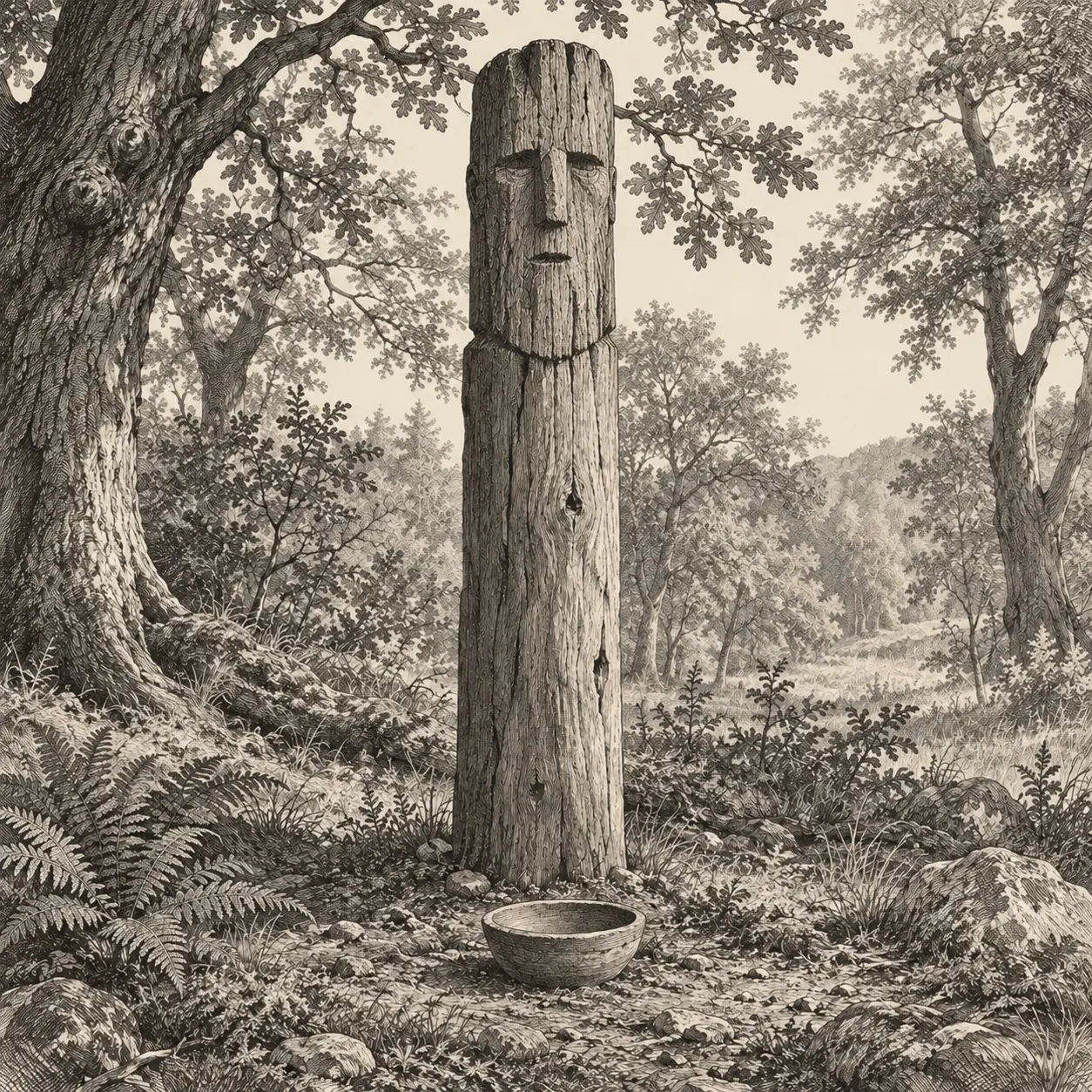
Religion in Practice
Fyrnsegen is a polytheistic religion. The gods are not treated as symbols, archetypes, or poetic ways of speaking about nature; they are approached as real beings with whom people and communities may stand in relationship.
Those bonds are maintained through practice. Prayer, offering, sacrifice, remembrance, hospitality, and the keeping of holy times and places all have their place, though they are not interchangeable acts. The form varies with circumstance; the underlying work is to maintain the proper relation between those who give, those who receive, and the order within which the rite takes place.
Ritual form therefore matters. A rite is not simply a sequence of inherited gestures performed because they are old; who gives, what is given, where the act occurs, how the space is ordered, and what the occasion requires all contribute to its meaning.
No complete Anglo-Saxon ritual book survives. Fyrnsegen must reconstruct much of its practice, and some forms have necessarily been instituted within the tradition itself; what matters is that each should make sense within the religious world we are trying to recover and continue to make sense when people gather to perform it.
Worship is where reconstruction ceases to be an argument on paper.
It becomes religion.
Gods, Forebears, and Wights
The religious world of Fyrnsegen is not occupied by the gods alone.
The gods stand at the centre of worship, but the dead, the forebears, and the beings of place also belong to the world with which religious life must reckon. These relationships are not interchangeable; a god is not approached as an ancestor, nor either as a wight associated with a household, boundary, water, field, or other place.
The gods are worshipped. They are addressed in prayer, honoured with offerings and sacrifice, and approached as beings whose favour and presence matter to the life of the household and cynn.
The forebears are remembered. That remembrance may be solemn, affectionate, formal, or ritualised, and may include offerings made in their memory; remembrance, however, is not simply another word for worship. Their place lies in continuity—in what has been inherited through blood, name, custom, land, obligation, memory, or example.
Wights belong differently to the ordered world. Fyrnsegen approaches them according to place and circumstance, with caution and respect rather than as a generic class of lesser gods.
Not everything holy is worshipped; not everything remembered is divine.
Learning the distinction is part of learning the tradition.
Hearth and Cynn
Fyrnsegen recognises both household and communal religious practice, but they are not simply smaller and larger versions of the same thing.
The hearth is the first setting in which religious life becomes habitual. Prayer, remembrance, ordinary offerings, the keeping of household holy places, and certain seasonal observances may all belong there; the household gives religion a daily and seasonal rhythm, weaving practice into ordinary life rather than reserving it for occasional gatherings.
The cynn carries a different weight. Communal worship requires common forms and a degree of discipline that private practice does not; roles must be understood, offerings prepared, space ordered, and the obligations created by worship carried together. A cynn also preserves memory in a way an individual household cannot: customs are repeated across years, taught to newcomers, corrected when necessary, and eventually handed on.
Neither sphere replaces the other. Religion lived only in private risks becoming entirely personal; religion encountered only at formal gatherings risks becoming detached from the ordinary life of its people.
The hearth gives practice intimacy and continuity; the cynn gives it communal form, memory, and accountability.