
Sacred Time
The Gerímbóc
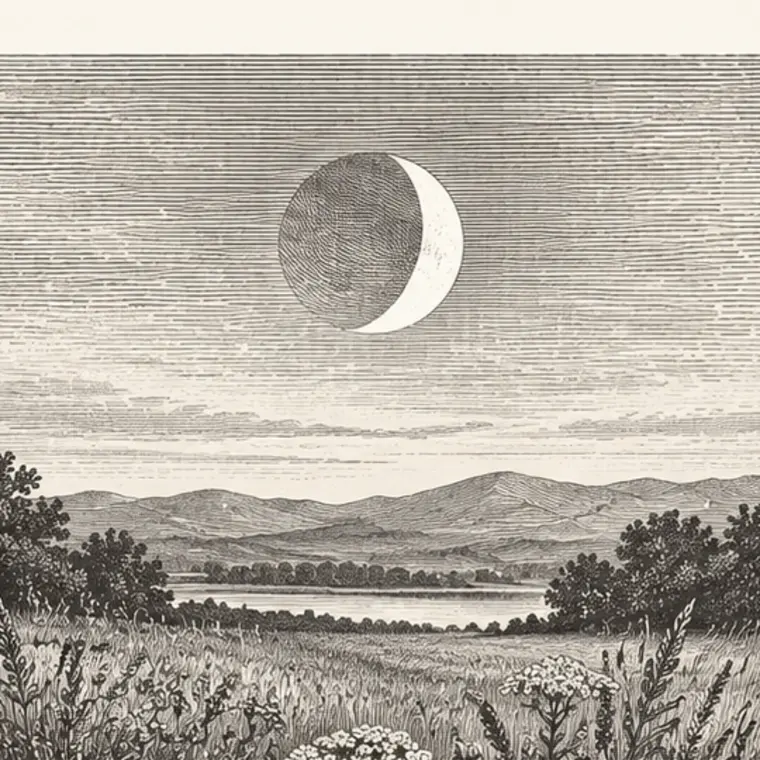
The Shape of the Year
Fyrnsegen does not treat the religious year as a sequence of festival dates laid over the modern civil calendar. Time has its own structure: the Moon renews and reaches fullness, the Sun moves through its greater stations, and the seasons change in ways that can be observed rather than merely named.
The surviving Anglo-Saxon calendar preserves enough of that structure to show that the year was reckoned differently from our own. Its months were lunar; the larger cycle remained in relation to the Sun, and intercalation was necessary to keep the two from drifting apart. The old month names therefore belong to a system, not simply to twelve convenient replacements for January through December.
Fyrnsegen has reconstructed that system into a working Gerímbóc. The reckoning draws upon Bede, later Old English usage, computistical evidence, comparative material, and observation of the heavens; where a calculated table and the sky finally disagree, the sky remains authoritative.
This matters because sacred time is not arbitrary. A holy tide belongs to a particular place within the year, and that place carries meaning. Géol stands at one station, Éostre at another; Midsumor and Winterfylleð likewise occupy their proper places within the turning cycle.
The calendar is more than a method of counting days.
It is a way of learning where we stand.
The Lunar Month
The lunar month is one of the basic measures of Fyrnsegen time. It begins with renewal, grows toward fullness, and wanes again toward darkness; the month is experienced as a cycle rather than as a fixed block of numbered days.
The changing Moon gives that cycle visible form. Its beginning can be observed, its fullness recognised, and its ending anticipated; time is not only recorded, but watched.
The surviving Anglo-Saxon month names belong within this rhythm. They do not map neatly upon the Roman months, nor begin simply because a civil calendar has turned a page. Their place is determined by the lunar cycle and by the larger need to keep the year aligned with Sun and season.
That alignment is not automatic. Twelve lunar months fall short of the solar year; from time to time an additional month must be inserted so that the reckoning does not wander from the seasonal world it is intended to describe.
The point is not merely computational. The lunar month restores a sense that the month itself possesses a visible beginning, fullness, and ending.
Reckoning and Observation
The Gerímbóc is a reckoning, not a substitute for the heavens.
Tables, cycles, and calculated dates allow the year to be anticipated and remembered; they give discipline to observance and make it possible for a cynn to keep a common calendar across many years. They remain, however, approximations of a living pattern. Sun, Moon, and season are not made true by the book.
Observation therefore has the final word. If a calculated cycle drifts from what can actually be seen, the reckoning must be corrected; the purpose of calculation is to remain faithful to the pattern, and when pattern and calculation part company, calculation has failed.
This is part of the method rather than a defect in it. A traditional calendar belongs to people who watch the sky, notice the season, and correct their reckoning when necessary.
The book remembers; the heavens correct.
Living in Sacred Time
The purpose of the Gerímbóc is not simply to calculate dates correctly. A calendar becomes religious when people live by it.
To keep sacred time is to allow the year to shape practice: when a cynn gathers, when a household prepares for a holy tide, when certain prayers or offerings are fitting, and when the movement of Sun, Moon, and season is allowed to interrupt the ordinary demands of the civil calendar. Reckoning gives these moments their place; observance gives them consequence.
Repeated across years, this creates memory. Géol becomes more than a date; Winterfylleð becomes recognisable not only by name, but by what the household and cynn do when it returns. Sacred time thereby becomes part of the inherited life of a community.
The Gerímbóc also teaches restraint. Not every month is a feast, not every lunar phase requires a rite, and not every seasonal change demands religious attention; the year contains times of gathering and times of ordinary life.
Fyrnsegen keeps the calendar as a discipline of attention: to notice where we stand, remember what belongs there, and return to the same stations with greater understanding when they come again.
The reckoning can be described briefly here; learning to keep it requires more.