
Writings & Resources · Cynn and office
The Þyle
Memory, Counsel, and Learned Speech in the Cynn
Learned Speech and Historical Ground
The Old English þyle, cognate with Old Norse þulr, belongs to a class of Germanic social terms that can be recognised more easily than they can be defined. The word is not common, its etymology is uncertain, and the surviving examples extend across several centuries and different literary settings. Attempts to give the þyle a precise office have consequently produced very different results. He has been described as an orator, counsellor, poet, cult-speaker, sage, rune-worker, diviner, and priest. Something can be said for most of these descriptions in particular cases, but none accounts satisfactorily for the evidence as a whole.
The firmer ground lies in the word itself and in the least elaborate of its attestations. Old Norse þylja means to recite or utter, apparently sometimes with the sense of sustained or low speech, while a þula is something recited. The þulr or þyle, at the broadest level, is therefore a speaker or reciter. Old English provides a still more useful gloss. In the Liber Scintillarum, Latin doctus orator is rendered gelæred þyle: a learned speaker. Other glosses associate þyle with oratores and þelcræft with rhetorica. Whatever other duties may at times have gathered around the role, learned and effective speech belongs very near its centre.
The earliest Scandinavian evidence points towards a setting in which such speech carried social weight. The Snoldelev stone, dated to the ninth century or earlier, commemorates Gunnvaldr, son of Hróaldr, as a þulr at Salhaugar. The place-name appears to combine a hall with a mound, and the stone itself bears a swastika and three drinking horns. The conjunction has naturally encouraged cultic interpretations, but it does not by itself establish the þulr as a priest. What it does establish is that the designation was sufficiently important to be cut in stone and that, at least in this instance, it belonged to the world of the hall, feast, and local eminence.
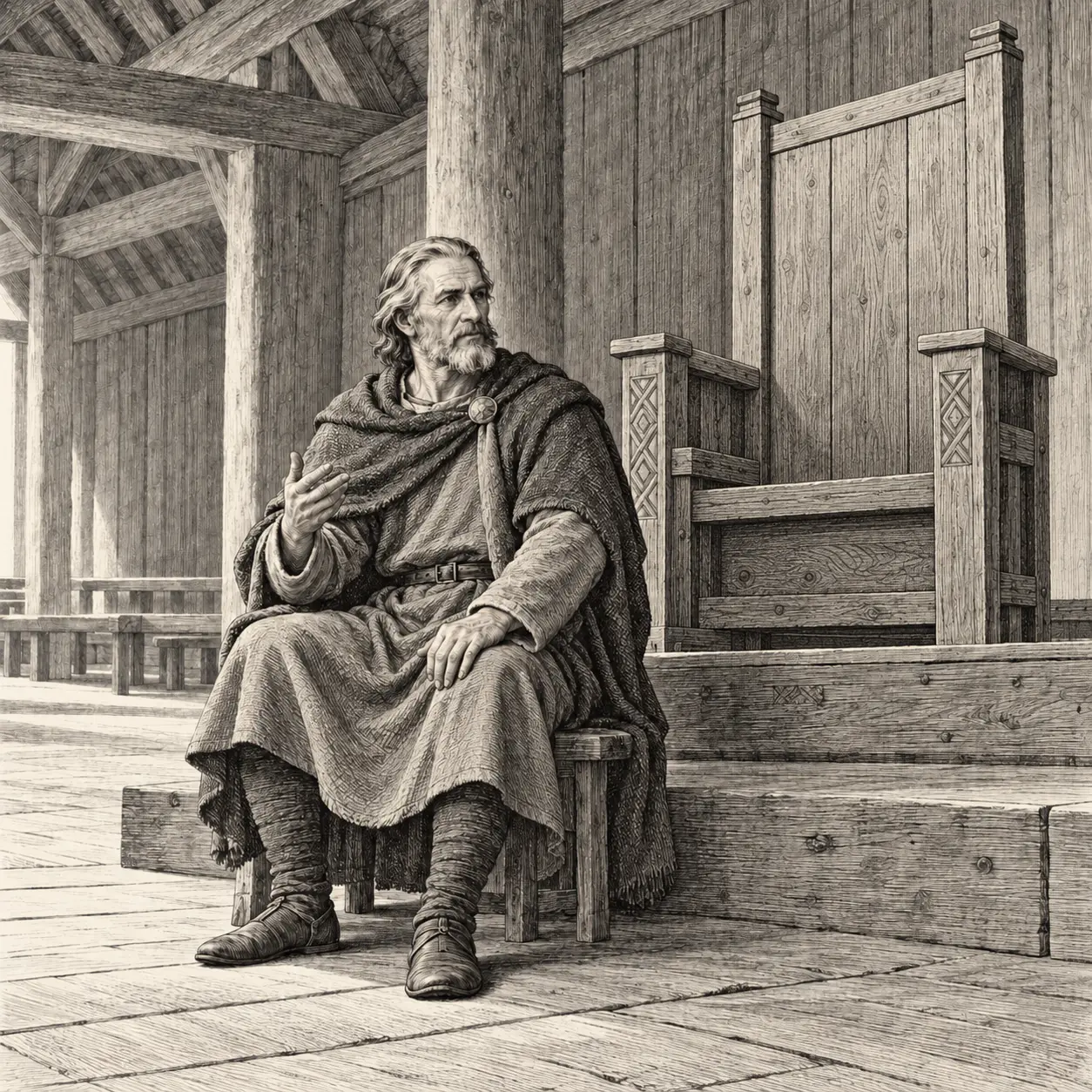
For an Anglo-Saxon reconstruction the most important witness is Unferð in Beowulf. He is Hroðgar’s þyle and occupies a recognised place close to the king. His function in the poem is revealed less by any formal description of his office than by what he does when Beowulf enters Heorot. Beowulf has arrived as a stranger making an extraordinary claim: he proposes to face the creature that has defeated Hroðgar’s own men and ravaged the hall for years. Unferð answers by bringing forward another story about Beowulf, the swimming contest with Breca, and uses it to challenge the reputation upon which Beowulf’s present claim rests. The RGA account reasonably sees here a counsellor drawing upon remembered persons and events in order to test an aspiring champion.
This exchange deserves more attention than it generally receives. Unferð’s challenge is certainly hostile at the level of the poem, and the poet has little interest in presenting him sympathetically. Yet his hostility does not make his intervention socially meaningless. Beowulf is required to answer him. A claim made before the king is subjected to remembered evidence before it is accepted. Unferð recalls what he believes to be an earlier failure and forces Beowulf to give an account of it. The result is not merely a contest of insults. Beowulf’s standing is tested before the hall.
The scene suggests a function for which there are good practical reasons in an oral society. Reputation was not an abstraction. It rested upon remembered deeds, relationships, promises, settlements, victories, failures, and the testimony of other men. Someone able to recall such matters and bring them to bear upon present claims would be useful to any ruler. Memory, in such a setting, had political force.
Memory, Counsel, and Inherited Knowledge
The Old Norse material cannot simply be projected backwards onto Anglo-Saxon England, but it helps to show the range of associations that remained attached to the word. In Vafþrúðnismál, Vafþrúðnir calls himself inn gamli þulr, the old þulr, during his contest of knowledge with Óðinn. The exchange takes place in the hall and is explicitly associated with sitting: Óðinn is invited to take a seat so that host and guest may discover which knows more. Here again the þulr is associated with formal speech, questioning, memory, and the testing of knowledge.
Hávamál develops the association still further. The speaker announces that it is time to þylja from the þular stóll, the seat of the þulr, beside Urðr’s well. What follows is instruction: counsel, practical wisdom, remembered lore, questions, runic knowledge, and material intended to be retained and passed on. The þulr is not merely performing. He is transmitting knowledge. The poem also describes the ideal recipient of such knowledge in terms that emphasise listening, perception, retention, and restraint.
These passages do not prove that an Anglo-Saxon þyle possessed a fixed curriculum or that a single Germanic office survived unchanged from the Migration Period into medieval Iceland. They do, however, help define the semantic field in which the term continued to operate. The recurring elements are learned speech, memory, counsel, instruction, questioning, and the public use of inherited knowledge.
Poetry belongs within this field, but the þyle should not be confused with the scop. Old Norse þylja can certainly describe poetic recitation, and poets use both the verb and þula of their compositions. Nevertheless, the RGA survey notes that þulr never becomes an ordinary synonym for skald or a regular term within the vocabulary of the comitatus. The distinction is useful. A poet may preserve memory and a þyle may use verse, but poetic composition is not what defines the latter. The Old English gloss gelæred þyle remains more instructive: learned speech is the craft.
The same caution is necessary when considering ritual and esoteric knowledge. Later Scandinavian sources bring the þulr and the verb þylja into proximity with runes, spells, prophecy, second sight, sacrifice, and unusual forms of muttered speech. Men withdraw beneath cloaks or speak into their hands; hidden things are revealed; poetry and supernatural knowledge meet. It is easy to gather these episodes together and produce a Germanic magician-priest. The evidence does not justify it. The RGA entry itself is careful on this point. Some scholars have emphasised sacrifice, augury, rune-mastery, and mediation with the gods, while another line of interpretation places the centre of the role in teaching and counsel grounded in accumulated traditional wisdom. The surviving figures need not all have exercised the same combination of functions.
For Fyrnsegen this distinction matters. There is no need to turn the þyle into another priestly office merely because some of the knowledge preserved by such a man may have concerned worship, ritual, or the gods. In a traditional society sacred knowledge is part of inherited knowledge. A man entrusted with preserving the speech and memory of a people would naturally know its rites, genealogies, stories, holy places, prohibitions, and forms of address. That does not mean that his authority arose principally from officiating at sacrifice.
The historical evidence therefore supports a reasonably coherent centre without requiring a precise institutional reconstruction. The þyle was a learned speaker. He could stand close to a ruler and offer counsel. He could draw upon memory to test the claims of others. Comparable Norse evidence connects the þulr with teaching, questioning, traditional wisdom, and formal recitation. Poetry and sacred lore could belong to his learning without defining the office. Beyond that point certainty gives way to reconstruction.
The Þyle within the Cynn
A Fyrnsegen cynn can work from this centre.
The most natural place for a þyle within the cynn would be as a keeper of memory and an adviser in matters where memory bears upon judgement. Modern circumstances change the means by which this work is done, but not necessarily the need for it. A contemporary cynn keeps written records; it need not depend upon one man’s unaided recollection of agreements made years before. Yet an archive does not interpret itself. Someone must know why a practice exists, how it developed, what evidence supported it, whether it was inherited or instituted, and how present claims compare with earlier decisions.
This work is particularly important for Fyrnsegen because Fyrnsegen is reconstructive. We constantly move among different kinds of knowledge. Some things are directly attested. Others are reconstructed from patterns in the evidence. Still others are practices we have consciously instituted because a functioning religious community requires decisions that the historical record cannot make for us. If these categories are allowed to collapse into one another, an instituted custom can become “ancient tradition” within a generation simply because nobody remembers when or why it began.
A þyle could serve as one safeguard against that process.
He should know the history of the cynn and the development of its customs. He should know which practices rest upon strong historical evidence and which upon more tentative reconstruction. Where the cynn has deliberately instituted something new, he should remember that as well. None of this requires him to possess final authority over interpretation. It requires him to be able to say, when necessary, that a custom is recent, that an argument has changed, that an older practice was abandoned for a reason, or that the evidence does not support what someone now claims for it.
The connection with Unferð becomes useful here. The þyle beside Hroðgar does not merely praise the man standing before the king. He remembers something that appears to contradict the man’s account of himself and puts it before him. In a modern cynn, the corresponding responsibility would not be ritualised insult, nor would there be any virtue in cultivating an institutional contrarian. It would be the recognised freedom to question a claim when memory or evidence gives reason to question it.
That responsibility becomes especially important when the claim concerns tradition. Revivalist religious communities are unusually vulnerable to confident invention. A practice begins because it seems reasonable; a few years later it is spoken of as something “we have always done”; eventually it acquires an imagined antiquity. A þyle who knows both the sources and the history of the community can interrupt that process before repetition becomes false pedigree.
This makes the office advisory rather than legislative. The þyle need not rule the cynn, preside over every gathering, or possess a special vote. His authority would lie in the weight given to informed recollection and considered speech. A lord or other leader may hear his counsel and choose another course. The þyle’s responsibility is fulfilled if the decision is made with the relevant memory before it rather than in ignorance of it.
The same principle applies at the þing. Where an earlier decision bears upon the matter before the cynn, the þyle should be able to recall it. Where a proposed practice is described as customary, he should know whether that description is justified. Where different accounts of an event have arisen, he should be able to distinguish what was recorded at the time from what has subsequently been remembered about it. He should also be capable of saying that no useful precedent exists. Filling gaps in the record with confident invention would be a failure of the office.
Teaching, Speech, and Qualification
Teaching follows naturally from the same responsibility. The knowledge of a cynn cannot be allowed to become the private possession of the person charged with remembering it. The þyle should pass on what he knows: the history of the community, the sources upon which its practices rest, its customary language, its important narratives, and the reasoning behind its institutions. The recurring association of the þulr with instruction makes this one of the less adventurous extensions of the historical material. More importantly, it prevents the office from becoming a bottleneck through which all knowledge must pass. A good þyle leaves other people more knowledgeable than he found them.
He would also have an obvious place in formal speech. The Old English evidence directly supports the connection between þyle and rhetoric, and the wider material associates the word with recitation. A Fyrnsegen þyle might therefore be called upon to recount the history of a rite, speak a genealogy, recite inherited verse, explain a precedent, or give formal counsel. This does not require that every prayer or ritual formula become his responsibility. It means that where the cynn requires someone to speak from knowledge rather than merely to speak well, the office is an appropriate one.
The qualifications follow from the function. The office would make little sense as an honour conferred for enthusiasm, seniority, or eloquence alone. The recurring picture is of knowledge accumulated and retained. A Fyrnsegen þyle should therefore have demonstrated command of the tradition, familiarity with its sources, knowledge of the history of the cynn, sound judgement, discretion, and the ability to distinguish evidence from inference. He must also be able to listen. A man who cannot revise his own recollection when better evidence is produced is not guarding memory; he is guarding himself.
There is likewise no reason to load the office with every activity ever associated with a þulr in later literature. Runic knowledge may be appropriate. Knowledge of ritual should certainly be expected. Skill in poetry would be valuable. None need be made the defining qualification. Prophecy, divination, and magical practice are still less suitable as requirements. They belong to the outer range of the evidence, not its centre.
The historical þyle remains elusive because the evidence never gives us the constitutional description we might like to possess. That is no reason either to abandon the word or to pretend that the missing description can be supplied. What survives is enough to identify a recognisable kind of social authority: the authority of the learned speaker whose words matter because he remembers, understands, and can bring inherited knowledge to bear upon present circumstances.
Such an office would answer a real need within a Fyrnsegen cynn. A living tradition must do more than preserve texts. It must remember its own decisions, distinguish inheritance from reconstruction, transmit what it has learned, and subject claims about the past to informed scrutiny. Those tasks do not require the invention of a new priesthood. They require someone willing to learn deeply, remember carefully, speak precisely, and answer for the integrity of what he says.
That is a role for which the old word þyle remains remarkably well suited.