
Colorado · The Front Range
Thriharandun Cynn
Three Hare Mountain
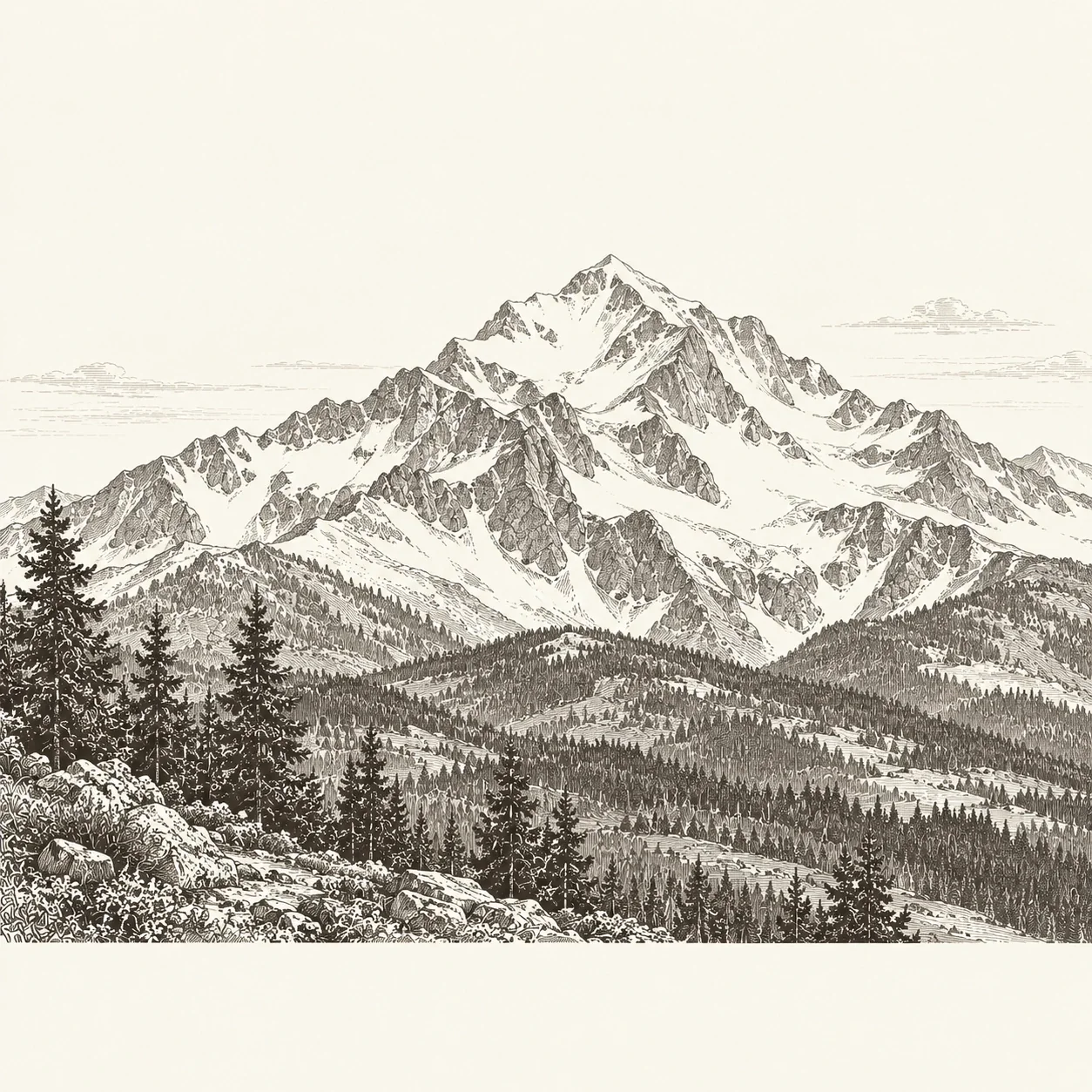
West winds wander over wheat-covered plains; grain bends in billows beneath the broad sky. Far fields fall back as the Front Range rises; stone shoulders stand with their summits in snow. Pines press upward where peaks pierce the cloud; cold creeks carry clear melt from the heights. Here hearths are tended and held among kin; gifts go to the gods where the great mountains rise.
From East to West
Three Hare Mountain Cynn—Thriharandun—is the Colorado cynn of Fyrnsegen and one of the founding cynnas of the tradition.
Our folk are found throughout south-central Colorado, beneath the great peaks of the Rocky Mountain Front Range.
Approach the West from the eastern shores of our country and the land opens before you. Across Kansas and eastern Colorado, wheat and corn stretch through the long miles; field follows field beneath a sky that seems to have no end. The wind moves over the grain as though over water. For hundreds of miles the earth rolls onward, a land-sea whose far shore remains out of sight.
Then the mountains rise.
At first they seem scarcely separate from the sky; then their shoulders darken and their snow-covered heights take shape. Like the slumbering forms of forgotten giants, they gather above the plains until they command the horizon. These are the mountains whose purple majesty found a voice in Katharine Lee Bates; her journey to the summit of Pikes Peak helped give us America the Beautiful.
In their shadow stands Thriharandun. Our name belongs to a particular encounter with the gods; our life belongs to this country of plains, foothills, and high mountains.
Three Hare Mountain
Thriharandun means “Three Hare Mountain.” The name remembers the encounter through which our cynn came to know the gods’ response to its worship.
More than a decade ago, our folk began putting into practice the reconstructed rites taught by those who would go on to form Fyrnsegen. Study had brought us to the point of offering; we had to do what we had learned and attend to what followed.
On a bitterly wintry May Eve, we brought a modest gift: three rabbits, raised lovingly by our own hands.
The gods answered.
That encounter was our formative hierophany: the occasion on which the gods made themselves known to us. It gave the cynn its name and a memory around which its life could grow.
The rabbits had required our care; the offering carried something of the work and affection with which they had been raised. “Three Hare Mountain” keeps that gift and the gods’ answer together. When we speak the name, we remember the beginning of an obligation which remains ours to tend.
The One-Eyed Wanderer
We hold Wóden, the One-Eyed Wanderer, as our éadgiefa—our luck-giver. He stands especially near to Thriharandun; this is our particular relationship within the wider Fyrnsegen tradition.
By luck we mean the good fortune through which a household or a people can endure and prosper. It concerns the conditions of our common life: what we can accomplish, what we can sustain, and what we may pass on to those who come after us.
To seek the god’s favour carries responsibilities. We must learn how to approach him, keep faith with what we undertake, and give the relationship a place in the life we actually lead. His gifts bring duties of their own; our part is to become capable of keeping them.
The Old Compacts
Our practice began as a humble religious experiment. Its starting proposition is plain: the gods are real; they are honourable; and they will heed the old compacts they entered into with our polytheistic ancestors.
The work falls to us to re-establish the terms of those compacts. We must recover what was offered and what was asked; how the gods were approached; what duties belonged to the people who sought their favour. That requires study, sound teaching, careful practice, and a willingness to correct our own misunderstandings.
Do ut des: we give that they might give.
The words express a relationship of giving and return. An offering places something of ours before the gods; their answering gift enters the life of the community. Such a relationship must be kept through time. Gratitude, good faith, and the fulfilment of obligations give substance to what we say at worship.
There is still much to recover and much to learn. The rites must be practised; their consequences must be attended to. Our encounter on that May Eve belongs within this continuing work, and it is one reason we persevere in it.
A Colorado Folkway
The religion of our tribal ancestors gives us the means to begin. Their understanding of gods, gifts, kinship, and obligation teaches us how to look upon the world; the surviving evidence helps us recover practices by which that understanding was made part of daily life.
We cannot recreate the whole of a Bronze Age or Iron Age society. Our task is to understand the worldview that sustained its religion and learn to live from it here, among the people and circumstances of our own time.
What might a twenty-first-century Colorado folkway look like when it grows from that inheritance?
The answer must take account of the country in which we live. The mountains and plains, the weather, the life of our towns, and the work by which our households are sustained all bear upon our practice. Colorado’s geography, history, and culture matter because they belong to the lives we bring before the gods.
To love Colorado as a mother is to know that our lives are sustained here and that we owe this country care. Such love grows through familiarity and responsibility; we learn the place, attend to its needs, and make a common life within it.
This is the folkway we seek to grow: rooted in the inherited religion, answerable to the gods, and at home in Colorado.
Thriharandun Today
Thriharandun is a living community of Fyrnsegen folk in Colorado Springs, Pueblo, and Cañon City. Shared worship, study, work, and the keeping of obligations give shape to our life together.
Those who live in our region and wish to learn about Fyrnsegen are welcome to inquire about visiting. You need not arrive knowing the rites or the Old English words; bring sincere questions, a willingness to learn, and respect for the people whose worship you hope to share.
If you love Colorado as the mother she is to us, and wish to explore a life of piety beneath these mountains, reach out and introduce yourself. Tell us where you live and what has brought you to Fyrnsegen; a conversation is a good beginning.
We welcome those who wish to visit Thriharandun and learn whether this common life may become their own.