
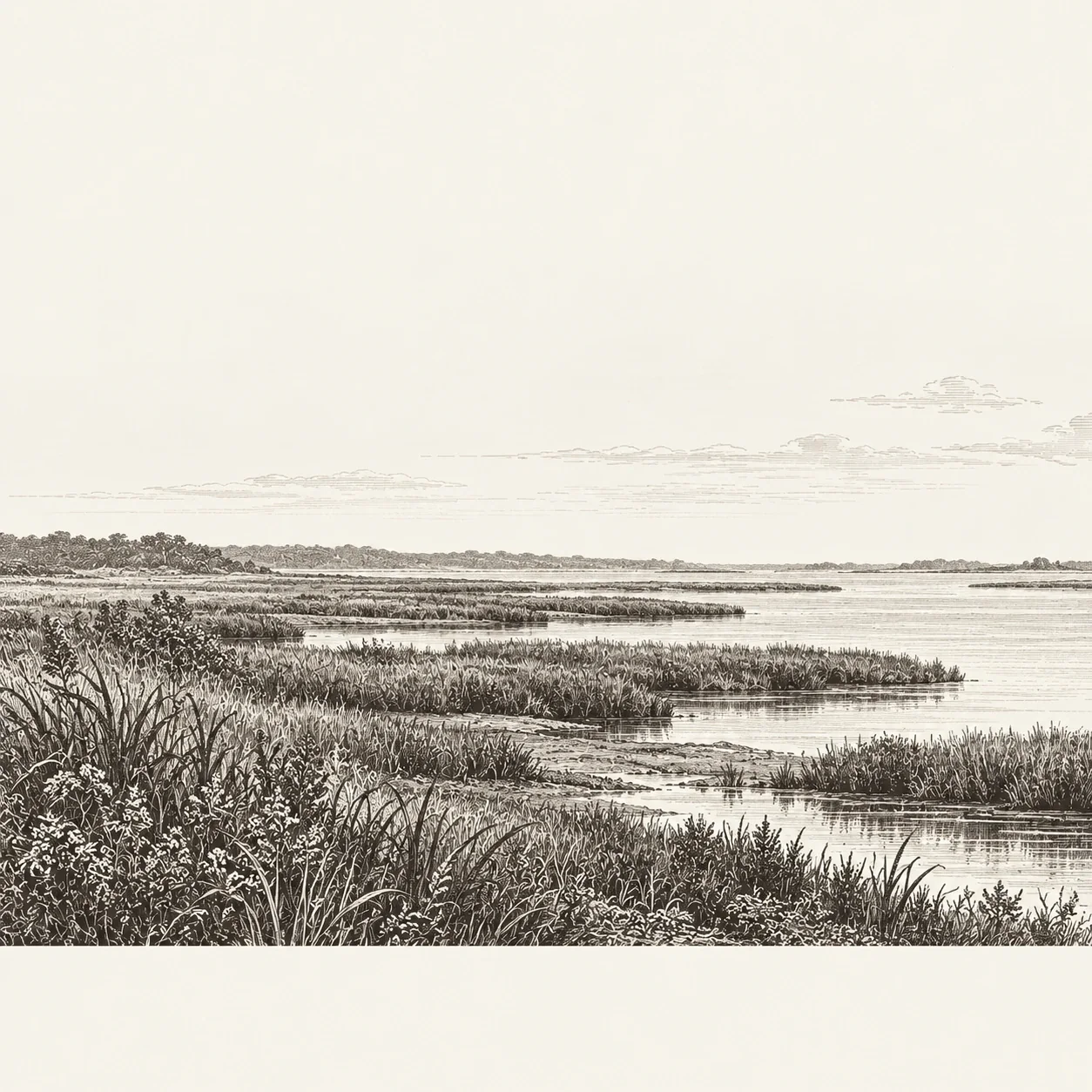
White waters widen where wind bends the sedge; marsh-grass murmurs at the meeting of tides. Bay-born billows bear inland the salt; rivers run seaward through reed-shadowed ground. Herons hold watch where high grasses whiten; moonlight moves on the mouths of the creeks. Land leans to water and water to land; at the hinge of the twohere Hwítmersc stands.
A founding cynn
Whitemarsh Cynn—Hwítmersc—is the Baltimore cynn of Fyrnsegen and one of the founding cynnas of the tradition.
Its home lies upon the Chesapeake and among the rivers, tidal creeks, marshes, and shores that gather around that great inland estuary. Our folk are found throughout Maryland and beyond it into Delaware, southern New Jersey, and southeastern Pennsylvania.
The name belongs first to the place.
A mersc is a marsh: the low country where water and earth meet, neither open water nor dry upland, but a ground shaped continually by both. Along the Chesapeake such places belong naturally to the landscape. Reeds and sedges rise from shallow water; creeks open into rivers; rivers widen toward the Bay; salt presses inland while fresh water runs seaward.
Hwítmersc, White Marsh, therefore names the country in which this cynn has taken root.
But the name also belongs to our theology.
Ing Frēa
Ing Frēa stands especially near to Whitemarsh. We know him as our éadgiefa: the giver of prosperity, fortunate condition, and the circumstances under which a people may flourish.
This is not “luck” understood as accident. The Old English ēad belongs to prosperity, blessed condition, happiness, and good fortune. Ing gives the conditions in which households can endure, land can bear, inheritance can pass, and a people can live within frith.
The Old English Rune Poem preserves only a few lines concerning him:
Ing wæs ǽrest mid Éast-Denum
gesewen secgun, oð hé siððan eft
ofer wæg gewát; wæn æfter ran;
þus Heardingas þone hæle nemdon.
The surviving story is compressed almost to its joints. Ing is first gesewen—seen—among the East-Danes. He remains among them for an unstated interval; afterward he goes back across the wave. A wain follows. The people continue to name the hero after he has gone.
The poem does not say that Ing was born among them.
It says that he was first seen.
That distinction matters.
At the Water’s Edge
The word transmitted as secgun, normalised secgum, is unusually rich. The conventional reading takes it as the dative plural of secg, “man,” so that Ing was “seen by men.” Grammatically, that remains the most immediate reading.
But Old English possesses another secg: the sedge, the sharp-bladed plant of wet ground. The same grammatical form can therefore also evoke sedges.
Within the Rune Poem itself this botanical language already belongs explicitly to wetland. The Ilugsecg stanza describes the sedge as dwelling in wet ground and growing in water. In the Ing stanza, the botanical resonance of secgum supplies something that “men” alone does not: a landscape.
Sedge gives us the wet margin.
The next movement gives us the wave.
The resulting image is striking:
sedge-grown margin → water → crossing
Ing becomes visible at the meeting of inhabited land and water; afterward he passes again across the wave. This does not require us to deny the ordinary reading “seen by men.” Old English permits both resonances to remain present where Modern English translation forces us to choose only one.
It is precisely this watery margin that brings Ing into relation with another story preserved by the English.
Sceafa
Old English and later English tradition remember Sceaf as a mysterious child who comes from across the water.
Æthelweard tells of the child arriving alone in a vessel, unknown to the people who find him and surrounded by weapons. They receive him, raise him, and eventually choose him as king.
William of Malmesbury preserves another form of the story. His child likewise comes unattended over the water, but a sheaf of grain lies at his head. He is received by the people and eventually reigns at Schleswig-Hedeby, in the country William identifies as Old Anglia, the continental homeland remembered for the Angles.
The stories are not identical to the Ing stanza, nor do we need to make them so. What they preserve is the same remarkable shape:
arrival over water → appearance among a people → reception → kingship
Fyrnsegen understands Sceafa within that relationship to Ing.
We do not regard him simply as another name for Ing; neither do we understand him merely as Ing’s biological child.
Sceafa is Ing Frēa gesewen.
He is Ing made visible within the human world.
The wording comes deliberately from the Rune Poem itself. Ing is first gesewen. His beginning is not described; his birth is not narrated. What the human community experiences is his becoming visible within its field.
Sceafa gives that visibility a body.
The child crosses the water. He is received upon the human shore. He grows among the people; kingship becomes present through him. The kingly order of Ing therefore enters a form human beings can encounter, receive, raise, remember, and follow.
Ing is not exhausted by Sceafa. The god remains greater than the manifestation through which he becomes visible.
Sceafa is Ing seen.
Why Whitemarsh
This is where the name of our cynn becomes more than geography.
The marsh is a threshold. Behind it lies inhabited land; before it lies navigable water. Sedges stand where one gives way to the other.
That is the landscape in which the Ing-Sceafa story becomes intelligible.
A child comes over the water. He reaches the sedge-grown margin. What was beyond the human field becomes visible within it. He is received; through that reception something capable of kingship, frith, provision, and flourishing enters the life of a people.
Whitemarsh stands today beside another great water.
The Chesapeake is an estuary of enormous scale, drawing rivers from far inland and opening ultimately toward the sea. Around its shores, marsh and tidal water repeatedly create the same meeting of worlds: firm land becoming sedge and reed; shallow water becoming channel; channel opening toward the greater Bay.
We did not need to invent that landscape for the story.
We live in it.
Hwítmersc names the place where our cynn stands; it also recalls the kind of place where Ing becomes gesewen.
For Whitemarsh Cynn, those meanings cannot be cleanly separated. The name joins place and god; marsh and crossing; appearance and reception; the water before us and the story inherited behind us.
It tells us where we are.
It also tells us something about whose people we have become.
Whitemarsh Today
Whitemarsh is a living cynn of the Fyrnsegen Tradition centered in the Baltimore and Chesapeake region. Our folk presently extend through Maryland, Delaware, southern New Jersey, and southeastern Pennsylvania.
Fyrnsegen is practiced in fellowship. A cynn is not a mailing list, an online affiliation, or a collection of people who happen to hold similar opinions. It is a community formed through shared practice, obligation, worship, and time.
Those within our region who are seriously interested in Fyrnsegen are welcome to contact us.
You do not need to arrive already knowing the Old English words, the rites, or the theology. You should arrive willing to learn what the tradition actually asks of those who approach it.
If you are in Maryland, Delaware, southern New Jersey, southeastern Pennsylvania, or the surrounding Chesapeake region and believe Fyrnsegen may be something you wish to approach, reach out to Whitemarsh Cynn and introduce yourself.